

How to Calculate Injection Molding Cycle Time
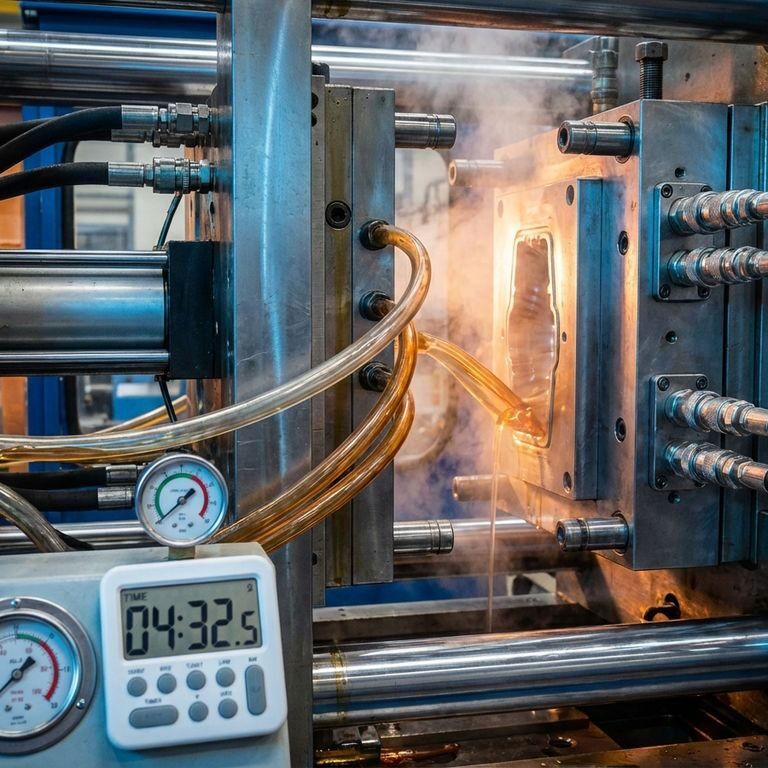
Injection molding cycle time is one of the most important performance indicators in plastic manufacturing. It represents the total time required to produce one finished part, from closing the mold to ejecting the molded component. Reducing cycle time without compromising quality is a key objective for manufacturers looking to improve productivity, lower production costs, and maximize machine utilization.
What Is Injection Molding Cycle Time?
Cycle time is the complete duration of a molding process. It includes every stage required to produce a finished plastic part:
- Mold closing
- Plastic injection
- Packing and holding pressure
- Part cooling
- Mold opening and part ejection
The total cycle time is the sum of these individual stages, and even small reductions can have a significant impact on production output over thousands of cycles.
Key Factors That Influence Cycle Time
Part Design
Wall thickness plays a major role in determining cooling time. Thicker sections retain heat longer, increasing the overall cycle duration. Designing parts with uniform wall thickness helps reduce cooling time while improving dimensional stability.
Material Selection
Every thermoplastic has different thermal properties, affecting injection speed, cooling requirements, and shrinkage. Selecting the right material for the application helps optimize processing efficiency.
Mold Design
An efficient mold design is essential for minimizing cycle time. Well-positioned cooling channels, balanced gating, proper venting, and optimized runner systems all contribute to faster and more consistent production.
Machine Parameters
Injection pressure, melt temperature, mold temperature, holding pressure, and clamp force must be carefully adjusted to achieve the shortest possible cycle while maintaining product quality.
How to Calculate Injection Molding Cycle Time
A simple way to estimate the total cycle time is:
Cycle Time = Injection Time + Holding Time + Cooling Time + Mold Opening/Closing + Part Ejection
Each of these phases can be measured during production or estimated during process development to identify opportunities for improvement.
Strategies to Reduce Cycle Time
Manufacturers can improve production efficiency by:
- Optimizing mold cooling circuits.
- Reducing unnecessary wall thickness.
- Fine-tuning injection parameters.
- Improving mold design.
- Performing preventive maintenance on molds and machines.
- Automating repetitive production tasks where appropriate.
Continuous optimization not only shortens production cycles but also reduces energy consumption and manufacturing costs.
Beyond Cycle Time: Don’t Overlook Changeover Efficiency
While reducing the molding cycle is essential, overall equipment productivity also depends on how quickly production can switch from one job to another. In many manufacturing facilities, mold changeovers represent a significant source of downtime that directly affects machine availability and production capacity.
An optimized changeover process allows manufacturers to increase machine uptime, improve scheduling flexibility, and respond more efficiently to shorter production runs or just-in-time manufacturing requirements.
How EAS Change Systems Helps Improve Overall Productivity
Reducing cycle time is only one part of maximizing injection molding efficiency. The time spent changing molds can also have a major impact on overall equipment effectiveness (OEE). This is where EAS Change Systems provides valuable solutions.
EAS specializes in mold change equipment designed to make changeovers faster, safer, and more efficient. By minimizing manual handling and reducing machine downtime, manufacturers can significantly increase productive machine hours.
Depending on the size of the molds and the production environment, EAS offers several solutions, including:
- Mold Change Tables for smooth and controlled mold transfers.
- Rolling Bolsters that allow heavy molds to move quickly in and out of the injection molding machine.
- Die Change Carts for safe transportation and positioning of molds.
- Quick Mold Clamping Systems that dramatically reduce clamping and unclamping time.
- Mold Storage and Handling Solutions that improve organization, accessibility, and operator safety.
These systems support lean manufacturing principles by reducing non-productive time, improving workplace safety, and enabling faster production changeovers. When combined with optimized injection molding cycle times, efficient mold change solutions help manufacturers maximize machine utilization, increase production capacity, and lower operating costs.
For companies looking to improve both production efficiency and changeover performance, EAS Change Systems provides practical solutions that contribute to higher productivity and a faster return on investment.
No comments