

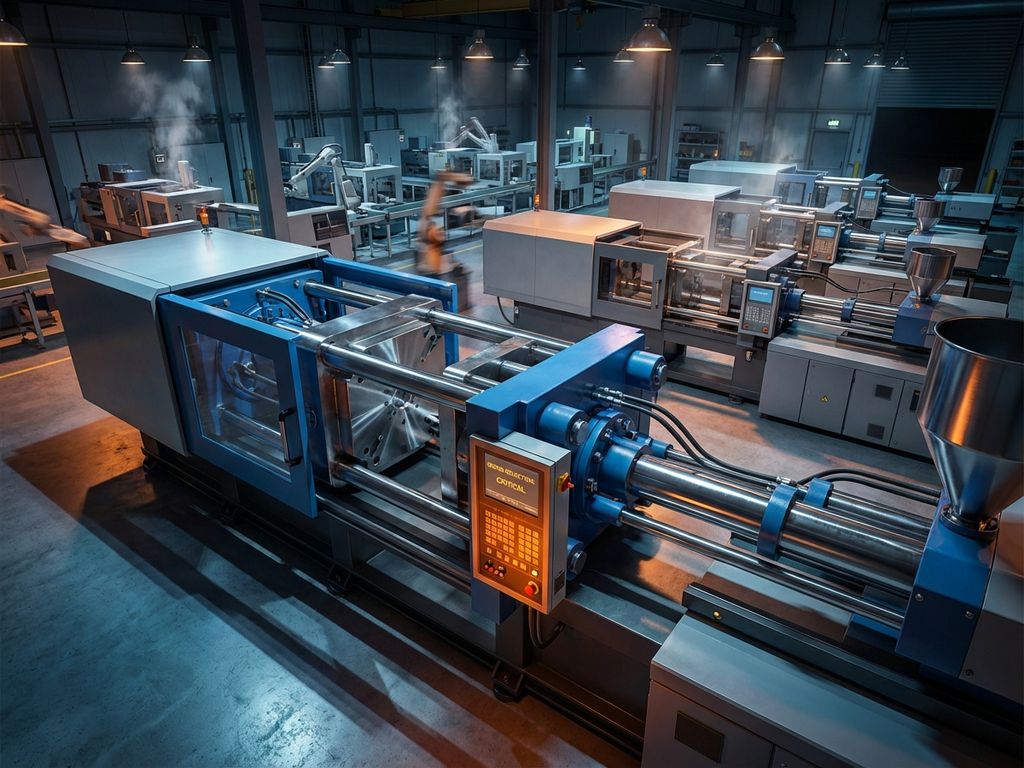
Choosing the right injection molding machine size depends on your part specifications, material requirements, and production volume. The machine must provide adequate clamping force, shot capacity, and platen size for your molds. Proper sizing ensures quality parts, efficient production, and cost-effective manufacturing operations.
What factors determine the right injection molding machine size?
The primary factors include part size and weight, material type, shot volume requirements, and clamping force needs. Your injection molding machine must accommodate the largest part dimensions while providing sufficient tonnage to keep the mold closed during injection.
Material properties significantly influence machine selection. High-viscosity materials require greater injection pressure, while glass-filled plastics demand more robust screws and barrels. Consider the material’s flow characteristics, shrinkage rates, and processing temperature requirements when evaluating machine capabilities.
Production volume expectations also guide sizing decisions. High-volume production benefits from larger machines with faster cycle times, while prototype or low-volume work may suit smaller, more flexible equipment. Factor in your facility’s power requirements, floor space limitations, and budget constraints during the selection process.
How do you calculate the clamping force needed for your injection molding project?
Calculate clamping force by multiplying the projected area of your part by the injection pressure, typically ranging from 2–8 tons per square inch of projected area. The projected area includes the part footprint plus runners and gates as viewed from the parting line direction.
Most thermoplastics require 3–5 tons per square inch, while engineering plastics often need 5–8 tons per square inch. Thin-walled parts, long flow paths, or high-pressure applications increase clamping force requirements. Always add a 20% safety margin to your calculations to account for material variations and processing conditions.
Consider the part’s complexity and wall thickness distribution. Parts with significant thickness variations or complex geometries may require higher clamping forces to prevent flash formation. Consult material suppliers for specific pressure recommendations, as different grades within the same plastic family can have varying requirements.
What’s the difference between machine tonnage and actual production capacity?
Machine tonnage refers to the maximum clamping force available, while production capacity encompasses cycle time, shot size limitations, and overall efficiency. A higher-tonnage machine doesn’t automatically mean faster or more efficient production for your specific application.
Production capacity depends on multiple variables, including injection speed, cooling time, mold complexity, and material characteristics. A 100-ton machine might outperform a 200-ton machine for smaller parts due to faster cycle times and lower energy consumption.
Shot capacity also limits production potential. The machine’s maximum shot size must accommodate your part volume plus runners and sprues, typically using 20–80% of available shot capacity for optimal performance. Exceeding recommended shot capacity percentages can result in inconsistent part quality and longer cycle times.
How do mold dimensions affect injection molding machine selection?
Mold dimensions must fit within the machine’s platen size and tie-bar spacing while allowing proper mold installation and maintenance access. The mold’s length, width, and height all influence machine compatibility and operational efficiency.
Platen size determines the maximum mold base dimensions you can accommodate. Ensure adequate clearance around the mold perimeter for clamps, connections, and safety access. The distance between tie bars limits mold width and may restrict your ability to run multi-cavity molds or large single-cavity parts.
Mold height affects the machine’s ability to accommodate ejector systems, cooling lines, and hot runner manifolds. Consider the fully assembled mold height, including all attachments, when evaluating machine compatibility. Some applications require mold rotation or tilting capabilities, which further influence machine selection requirements.
What common mistakes should you avoid when sizing injection molding machines?
The most frequent mistake is undersizing clamping force, leading to flash, dimensional inconsistencies, and quality problems. Conversely, oversizing wastes energy and increases operating costs without improving part quality or cycle times.
Many manufacturers overlook shot capacity requirements, focusing only on tonnage. Insufficient shot size prevents proper cavity filling, while excessive capacity reduces control over material residence time. Always verify that your part volume plus runners falls within the machine’s optimal shot range.
Ignoring future production needs creates limitations as your business grows. Consider potential part modifications, cavity increases, or material changes when selecting equipment. Additionally, failing to account for auxiliary equipment space, utility requirements, and maintenance access can create operational challenges that impact productivity and safety.
How EAS change systems help with injection molding machine optimization
We provide comprehensive quick mold change solutions that maximize your injection molding machine utilization and production efficiency. Our products dramatically reduce changeover times from hours to minutes, enabling more flexible production scheduling and improved overall equipment effectiveness.
Our injection molding optimization solutions include:
- Adaptive clamping systems for secure, rapid mold mounting
- Automated coupler systems for quick utility connections
- Mold transportation and positioning equipment
- Integration engineering for seamless machine compatibility
- ROI calculations to demonstrate productivity improvements
Whether you’re running high-mix, low-volume production or need to optimize changeovers between different part families, our quick mold change systems help you achieve maximum machine utilization. Contact our application engineers today to discuss how we can optimize your injection molding operations and reduce setup times across your production facility.