

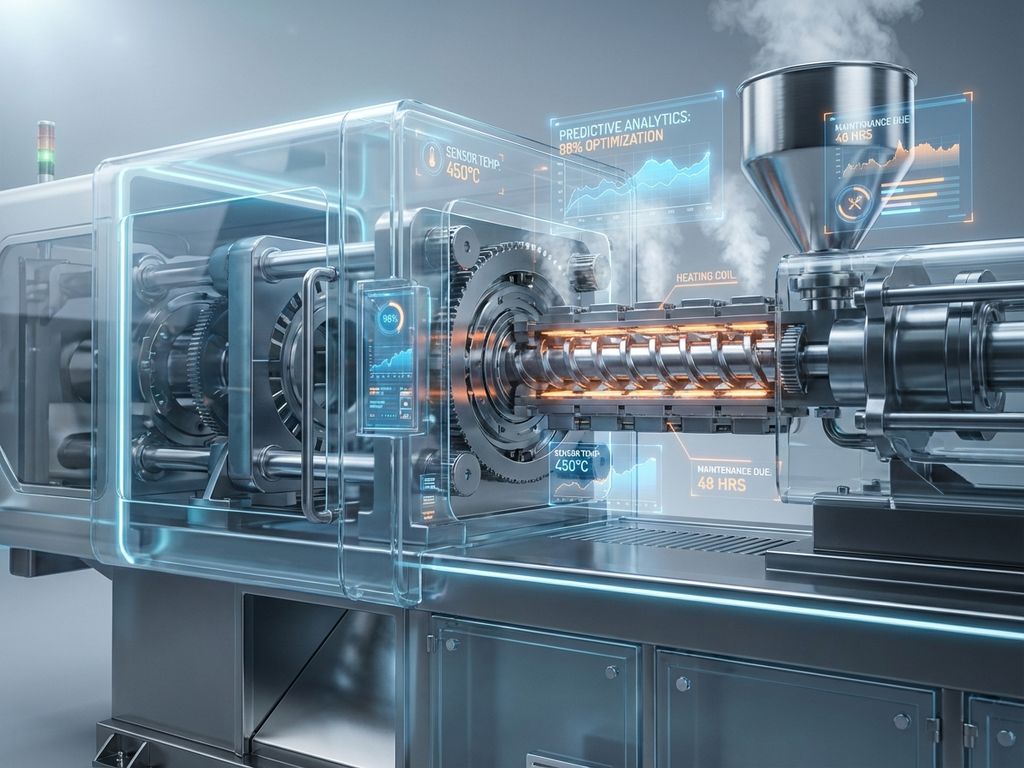
Predictive maintenance uses data analysis and monitoring technology to predict when injection molding equipment might fail, allowing repairs before breakdowns occur. This approach prevents costly downtime, reduces emergency repairs, and extends equipment life. Understanding how predictive maintenance works helps manufacturers maintain consistent production while controlling maintenance costs.
What is predictive maintenance and why does injection molding need it?
Predictive maintenance monitors equipment condition through sensors and data analysis to forecast when maintenance is needed. Unlike reactive maintenance, which waits for failures, it identifies potential problems early through temperature readings, vibration patterns, and performance metrics.
Injection molding operations particularly benefit from predictive maintenance because unplanned downtime is extremely costly. When a molding machine stops unexpectedly, it affects the entire production line, wastes materials, and delays customer deliveries. The precision required in injection molding means even minor component wear can impact product quality.
Modern injection molding machines contain numerous components that wear predictably, including heating elements, hydraulic systems, and mechanical parts. By monitoring these systems continuously, manufacturers can schedule maintenance during planned downtime rather than experiencing emergency shutdowns.
How does predictive maintenance actually work in injection molding operations?
Predictive maintenance systems collect real-time data from sensors placed throughout injection molding equipment. These sensors monitor temperature, pressure, vibration, electrical current, and cycle times to establish baseline performance patterns and detect deviations.
The process begins with installing monitoring equipment on critical components such as motors, pumps, heater bands, and hydraulic systems. Data collection systems record normal operating parameters during optimal machine performance. Advanced software then analyzes this information to identify trends that indicate developing problems.
When sensor readings deviate from normal patterns, the system generates alerts for maintenance teams. For example, increased vibration in a pump might indicate bearing wear, while temperature fluctuations in heating zones could signal element degradation. This early warning allows technicians to plan repairs before complete failure occurs.
What are the most common injection molding equipment failures that predictive maintenance can prevent?
Heating system failures are among the most predictable problems in injection molding. Heater bands and cartridge heaters show declining performance through temperature inconsistencies and increased power consumption before complete failure.
Hydraulic system issues represent another major category of preventable failures. Pump wear, seal degradation, and fluid contamination create detectable changes in pressure patterns and system performance. Monitoring hydraulic pressure and flow rates helps identify these problems early.
Motor and drive system failures often announce themselves through vibration changes, current-draw variations, and speed inconsistencies. Predictive maintenance systems can detect bearing wear, alignment issues, and electrical problems before they cause complete motor failure.
Screw and barrel wear affects product quality and processing efficiency. Monitoring injection pressure, screw torque, and cycle consistency helps identify when these critical components need attention. Temperature sensors can also detect hot spots that indicate excessive wear or damage.
What’s the difference between predictive maintenance and traditional maintenance approaches?
Traditional reactive maintenance waits for equipment to fail before taking action, resulting in unplanned downtime and emergency repair costs. Preventive maintenance schedules regular service regardless of actual equipment condition, potentially replacing components that still have useful life remaining.
Predictive maintenance bridges these approaches by using actual equipment condition to guide maintenance decisions. Instead of changing parts on a fixed schedule or waiting for failure, maintenance occurs when data indicates it is actually needed.
The cost implications differ significantly between approaches. Reactive maintenance creates the highest costs through emergency repairs, overtime labor, and production losses. Preventive maintenance reduces failures but may waste money on unnecessary part replacements. Predictive maintenance optimizes both equipment reliability and maintenance spending.
Resource allocation also varies between methods. Traditional approaches require either large emergency repair budgets or extensive preventive maintenance schedules. Predictive maintenance allows more efficient resource planning based on actual equipment needs rather than estimates or emergency responses.
How do you implement predictive maintenance in an injection molding facility?
Implementation begins with identifying critical equipment and failure points that would most impact production. Focus on machines with the highest downtime costs and components with predictable wear patterns to maximize initial program value.
Installing appropriate monitoring equipment comes next. Temperature sensors, vibration monitors, pressure transducers, and current meters provide the data foundation for predictive analysis. Choose sensors that can withstand the injection molding environment’s heat, pressure, and chemical exposure.
Data collection and analysis systems require careful selection based on facility size and complexity. Simple systems might use handheld instruments for periodic readings, while larger operations benefit from automated monitoring with central data analysis. The key is matching system sophistication to actual facility needs and technical capabilities.
Training maintenance staff represents a crucial implementation step. Technicians need to understand how to interpret predictive maintenance data and translate alerts into appropriate maintenance actions. This includes learning to distinguish between normal operational variations and genuine problem indicators.
How EAS change systems support predictive maintenance strategies
We design our quick mold change systems with built-in monitoring capabilities that support predictive maintenance programs. Our adaptive clamping systems include sensors that track clamping-force consistency and detect wear in critical components before failures occur.
Our comprehensive solutions enhance predictive maintenance through:
- Integrated monitoring systems in mold-change tables and transportation vehicles
- Diagnostic capabilities in mono and multi-coupler systems
- Performance-tracking features in ejector couplers and inspection units
- Predictive analytics support through our application engineering services
- Maintenance optimization as part of our ROI calculation services
Ready to implement predictive maintenance with equipment designed for monitoring and reliability? Contact our application engineering team to discuss how our smart mold change solutions can support your predictive maintenance strategy while reducing setup times and improving overall equipment effectiveness.