

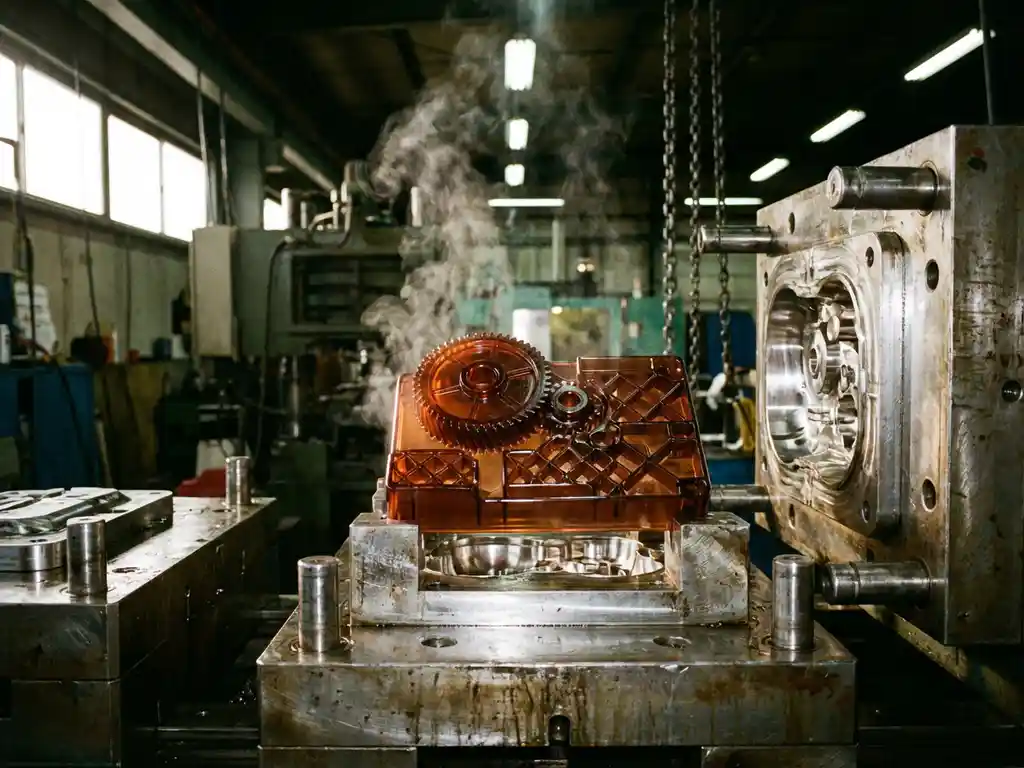
Design for manufacturability in injection molding involves designing plastic parts with manufacturing constraints and capabilities in mind from the earliest design stages. This approach considers mold design, material flow, cooling requirements, and production efficiency to create parts that are both functional and cost-effective to manufacture. Proper DFM reduces defects, shortens cycle times, and minimizes expensive tooling modifications during production.
What exactly is design for manufacturability in injection molding?
Design for manufacturability (DFM) in injection molding is a systematic approach that integrates manufacturing considerations directly into the part design process. It involves evaluating how design decisions will impact mold construction, material flow, cooling efficiency, and overall production costs before manufacturing begins.
The core principle centers on designing plastic components that work harmoniously with the injection molding process rather than fighting against it. This means considering factors such as polymer behavior, mold-filling patterns, and ejection requirements during the initial design phases. Engineers must balance functional requirements with manufacturing realities to create parts that perform well while remaining economical to produce.
DFM encompasses everything from basic geometric considerations to complex material flow analysis. It requires understanding how plastic behaves under injection pressure, how it cools and shrinks, and how these factors affect dimensional accuracy and surface quality. The goal is to create designs that fill completely, cool uniformly, and eject cleanly from the mold.
Why does design for manufacturability matter so much in injection molding?
Design for manufacturability significantly impacts production costs, quality consistency, and manufacturing efficiency in injection molding operations. Poor DFM decisions made early in development can result in expensive tooling modifications, extended cycle times, and higher scrap rates throughout the product’s manufacturing life.
The financial implications are substantial because mold modifications after production begins are extremely costly. Simple design changes that seem minor can require extensive mold rework, including machining new cavities, adjusting cooling lines, or completely rebuilding sections. These modifications not only cost money but also cause production delays and potential quality issues.
Quality benefits extend beyond cost savings. Parts designed with proper DFM principles exhibit more consistent dimensions, better surface finishes, and fewer manufacturing defects. This consistency reduces quality control issues, warranty claims, and customer complaints. Additionally, well-designed parts often have shorter cycle times, allowing manufacturers to produce more parts per hour and improve overall equipment effectiveness.
Manufacturing flexibility also improves with good DFM practices. Parts that are easier to mold adapt better to different production scenarios and equipment capabilities. This flexibility becomes particularly valuable when scaling production or transferring manufacturing to different facilities.
What are the key design for manufacturability principles every engineer should know?
Fundamental DFM principles include maintaining uniform wall thickness, incorporating appropriate draft angles, minimizing undercuts, optimizing gate placement, and ensuring proper material flow paths. These principles work together to create parts that fill completely, cool evenly, and eject reliably from the mold.
Wall thickness uniformity prevents differential cooling rates that cause warping, sink marks, and internal stresses. Variations should be gradual rather than abrupt, with thickness changes occurring over adequate distances. Thick sections should include ribs or coring to maintain structural strength while reducing material usage and cooling time.
Draft angles facilitate part ejection by preventing the part from sticking in the mold. Vertical surfaces should include slight tapers, typically 0.5 to 2 degrees, depending on surface texture and part depth. Textured surfaces require additional draft to compensate for increased surface friction during ejection.
Undercut avoidance simplifies mold construction and reduces costs. When undercuts are necessary for functionality, they should be designed to work with standard side-action mechanisms or designed with acceptable draft angles. Complex undercuts requiring multiple actions significantly increase mold complexity and maintenance requirements.
Gate placement affects filling patterns, weld-line formation, and surface appearance. Gates should be positioned to promote balanced filling while minimizing visible gate marks on critical surfaces. Multiple gates may be necessary for large or complex parts to ensure complete filling and acceptable cycle times.
How does poor design for manufacturability impact injection molding operations?
Poor DFM creates cascading problems, including extended cycle times, increased scrap rates, complex tooling requirements, and reduced production flexibility. These issues directly impact manufacturing costs and can make otherwise viable products economically unfeasible to produce.
Extended cycle times result from parts that are difficult to fill or cool properly. Thick sections require longer cooling periods, while poor gate placement may necessitate higher injection pressures and longer fill times. These extended cycles reduce hourly production rates and increase per-part manufacturing costs.
Higher scrap rates occur when parts consistently fail to meet quality standards due to design-related issues. Common problems include incomplete filling, excessive warpage, visible weld lines in critical areas, and ejection damage. Each rejected part represents wasted material, energy, and machine time.
Complex tooling requirements drive up initial mold costs and ongoing maintenance expenses. Molds with multiple actions, complex cooling circuits, or difficult-to-access areas require more sophisticated construction and specialized maintenance procedures. This complexity also increases the likelihood of mold-related production interruptions.
Production flexibility suffers when parts are designed without considering manufacturing variations. Parts that only work within narrow processing windows are difficult to optimize and may not transfer successfully between different machines or facilities. This limitation becomes particularly problematic when implementing quick mold change systems for flexible manufacturing operations, as poorly designed parts may not adapt well to rapid changeover requirements.
The cumulative effect of these issues extends beyond immediate production costs. Poor DFM decisions can limit a manufacturer’s ability to respond quickly to market demands, implement lean manufacturing principles, or achieve the production flexibility necessary for competitive advantage in today’s manufacturing environment.
How EAS Change Systems helps with design for manufacturability optimization
EAS Change Systems provides comprehensive solutions that bridge the gap between optimal part design and efficient manufacturing operations. Our expertise helps manufacturers implement DFM principles while maximizing production flexibility and minimizing changeover-related inefficiencies. We work with engineering teams to evaluate designs from both functional and manufacturing perspectives, ensuring parts are optimized for rapid mold changes and consistent quality across production runs.
Our solutions include:
- DFM consultation services that identify potential manufacturing issues before tooling begins
- Quick-change mold systems designed to accommodate well-engineered parts with minimal setup time
- Production optimization strategies that leverage proper DFM to reduce cycle times and improve quality
- Training programs that help engineering teams understand the relationship between design decisions and manufacturing efficiency
Ready to optimize your injection molding operations through better design for manufacturability? Contact EAS Change Systems today to discover how our integrated approach can reduce your production costs while improving part quality and manufacturing flexibility.