

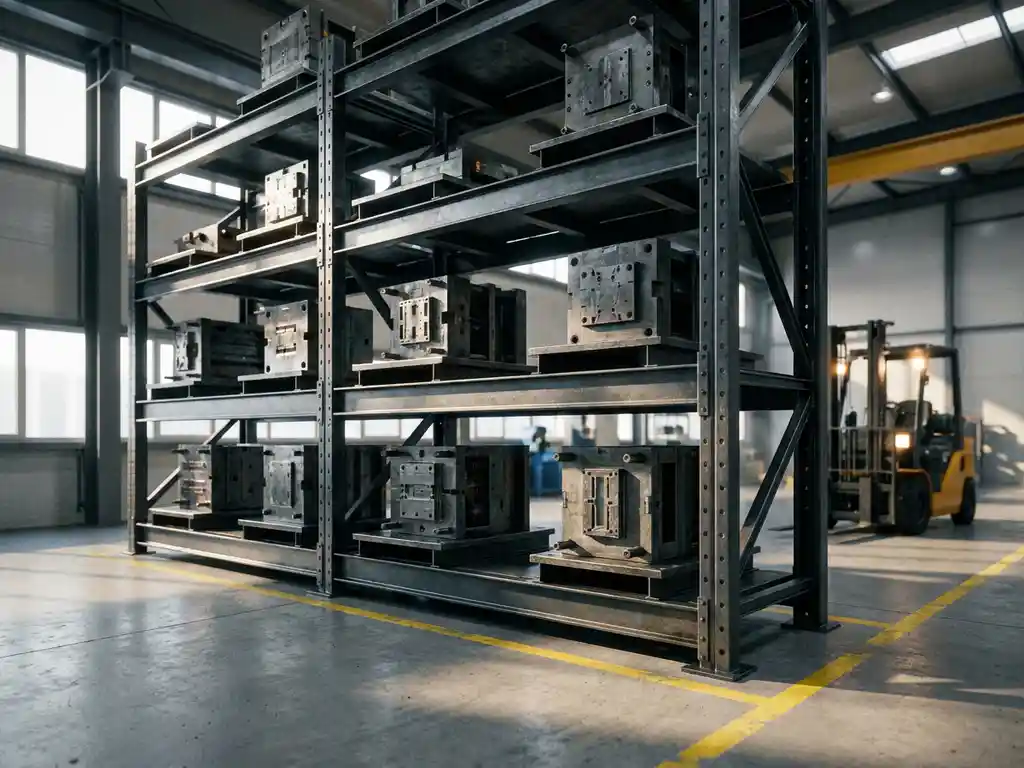
A mold storage rack is a structured shelving or racking system designed to safely store injection molds when they are not in active production. These systems support the weight of heavy molds, protect them from damage, and keep them organized and accessible. The sections below cover the types available, how they protect your tooling, and what to look for when choosing one.
What types of mold storage racks are available?
Mold storage racks come in several configurations, each suited to different mold sizes, facility layouts, and handling requirements. The most common types are static shelving racks, cantilever racks, and drawer-style or pull-out racking systems. The right choice depends on how many molds you store, how frequently you access them, and how much floor space you have available.
Static shelving and cantilever racks
Static shelving racks are the most straightforward option. They consist of fixed horizontal shelves supported by a steel frame. These work well for molds of uniform size and moderate weight. Cantilever racks remove the front vertical supports, making it easier to slide molds in and out without obstruction. They are particularly useful for long or awkwardly shaped tooling that does not fit neatly onto standard shelves.
Drawer-style and pull-out systems
Drawer-style storage racks allow molds to be pulled out horizontally on sliding platforms, giving technicians full access without lifting or repositioning. These systems significantly reduce manual handling and work well in environments where ergonomics and speed of access are priorities. Some facilities combine pull-out drawers with integrated rollers or lift assists to move heavier molds with minimal effort.
How does a mold storage rack keep molds safe?
A mold storage rack protects molds by distributing their weight evenly, preventing contact damage between tools, and keeping them in a stable, controlled position. Molds are precision instruments. Even minor dents, surface contamination, or mishandling can lead to production defects or costly repairs. A proper storage rack eliminates the improvised stacking or floor storage that causes most tooling damage.
Beyond physical support, well-designed racks often include features like non-slip surfaces, protective liners, and designated slots that prevent molds from shifting during storage. Some facilities add desiccant systems or controlled environments near their racking to reduce moisture exposure, which is a common cause of corrosion on mold cavities and parting surfaces. Keeping molds clean, supported, and clearly labeled on a dedicated rack is one of the simplest ways to extend tooling life and reduce maintenance costs.
What’s the difference between mold storage and mold management?
Mold storage refers specifically to the physical housing of molds when they are not in use. Mold management is a broader concept that covers the full lifecycle of a mold, including maintenance scheduling, condition tracking, cleaning, inspection, and repair history. Storage is one component of mold management, but the two terms are not interchangeable.
A facility can have excellent racking but poor mold management if there is no system for tracking which molds have been serviced, when they were last used, or what condition they are in. Conversely, strong mold management practices depend on organized storage as a foundation. When molds are easy to locate, access, and inspect, maintenance becomes faster and more consistent. Integrating a storage rack into a broader mold management workflow, which might include inspection logs, cleaning protocols, and maintenance schedules, turns a passive storage solution into an active quality control tool. To learn more about how these workflows come together, explore our range of mold handling applications.
How does mold storage connect to quick mold change systems?
Mold storage and quick mold change (QMC) systems work together as part of the same production workflow. A quick mold change system reduces the time it takes to swap a mold on an injection molding machine. For that speed advantage to be realized, the replacement mold must be immediately accessible, correctly prepared, and positioned close to the press. That is where organized mold storage becomes essential.
If molds are scattered across a warehouse or stacked without a clear system, even the fastest clamping technology cannot compensate for the time lost locating and retrieving the next tool. Purpose-built storage racks positioned near the press area, combined with mold change tables or transport vehicles, create a seamless handoff between storage and production. The result is a significantly shorter total changeover time, not just a faster clamping step.
Some facilities take this further by integrating mold transport vehicles or pre-staging areas directly adjacent to the press. In these setups, the storage rack, transport system, and quick change equipment form a connected workflow rather than three separate tasks. Browse our full range of products to see how these components work together.
What should you consider when choosing a mold storage rack?
When choosing a mold storage rack, the most important factors are load capacity, mold dimensions, access frequency, and available floor space. Getting these right from the start prevents costly upgrades or workarounds later.
- Load capacity: Each shelf or drawer must comfortably support the weight of your heaviest molds, with a safety margin. Never size a rack based on average mold weight alone.
- Mold dimensions: Measure your largest molds and ensure the rack accommodates them without forcing or overhang. Account for future tooling additions if your mold inventory is likely to grow.
- Access frequency: Molds used daily need quick, ergonomic access. Molds used rarely can be stored higher or in less convenient positions. Match the rack layout to actual usage patterns.
- Floor space and layout: Consider aisle widths, forklift or transport vehicle clearance, and proximity to the press area. A rack that is hard to reach defeats its own purpose.
- Material and finish: Industrial racking should be built from heavy-gauge steel with a corrosion-resistant coating, especially in environments with humidity or cleaning agents.
- Labeling and identification: Plan for clear, consistent labeling from the start. Visual management systems, such as color coding or barcode slots, reduce retrieval time and human error.
It is also worth thinking about future scalability. A modular racking system that can be expanded or reconfigured as your mold inventory changes will serve you far longer than a fixed system built only for current needs.
How EAS Change Systems helps with mold storage and mold management
We at EAS Change Systems design and supply solutions that go well beyond the rack itself. Our approach connects mold storage to the full production workflow, helping manufacturers reduce changeover times, protect their tooling investment, and maintain molds in optimal condition. Here is what we offer in this area:
- Mold change tables and transport vehicles that bridge the gap between storage and press, making mold retrieval and positioning fast and safe
- Inspection units, mold rotators, and inspection tables that allow thorough mold checks before and after production runs
- Tool Care program that advises and supports customers in introducing molds into production in the best technically optimal condition, including maintenance scheduling and condition tracking
- Application engineering and project management to design a storage and change system that fits your specific press layout, mold inventory, and production volumes
- ROI calculations so you can see the measurable impact of a well-integrated storage and quick change setup before you invest
Whether you are setting up a new facility or improving an existing one, we are ready to help you build a mold storage and management setup that works as part of a complete quick mold change system. Contact us today to discuss your requirements and find out what the right solution looks like for your operation.