
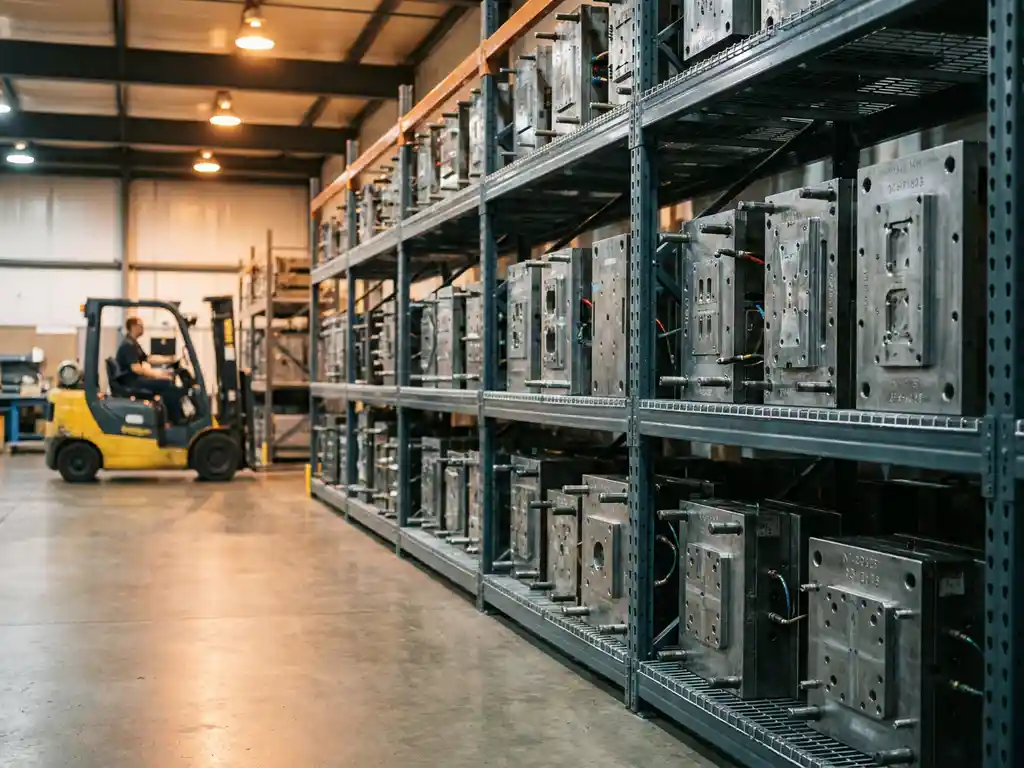
Racking for mold storage delivers real, measurable benefits to any injection molding or die casting operation. A well-designed mold storage rack keeps tools organized, protected, and ready for fast retrieval, which directly reduces downtime and extends mold service life. The sections below unpack the most common questions manufacturers ask before investing in a racking system.
How does racking improve mold organization on the shop floor?
Mold storage racking improves shop floor organization by giving every tool a fixed, labeled location that operators can find quickly and safely. Instead of stacking molds on pallets or leaving them on the floor, a dedicated storage rack creates a structured inventory system where molds are accessible, visible, and stored at a consistent height that supports safe handling.
Good organization has a direct impact on production efficiency. When operators know exactly where each mold is stored, they spend less time searching and more time running production. Racking also makes it straightforward to implement a first-in, first-out rotation for molds that share similar cavities, which helps distribute wear evenly across your tool inventory.
Beyond retrieval speed, a racking system supports better maintenance scheduling. When molds are stored in a consistent, visible location, it is far easier to attach maintenance tags, track inspection dates, and ensure no tool goes back into production before it has been properly serviced.
What damage risks does proper mold storage prevent?
Proper mold storage racking prevents damage caused by impact, moisture, contamination, and improper stacking. These are the four most common sources of mold deterioration outside of active production, and each one is largely avoidable with the right storage setup.
- Impact damage: Molds stored on the floor or stacked on top of one another are vulnerable to forklift collisions and dropped loads. A dedicated rack keeps each mold in its own bay, eliminating the risk of tools knocking against each other.
- Moisture and corrosion: Molds stored directly on concrete floors are exposed to moisture wicking up from the ground. Raised rack shelves with appropriate surface coatings keep tools dry and reduce the risk of rust forming on parting surfaces and cavity details.
- Contamination: Dust, coolant splatter, and metal chips can settle into open cavities when molds are stored without covers in open floor areas. Racking combined with protective covers keeps cavity surfaces clean between production runs.
- Structural stress from improper stacking: Heavy molds stacked directly on top of lighter ones can warp or crack the lower tool over time. Racking eliminates this risk entirely by distributing each mold’s weight through its own support structure.
Preventing these damage types is not just about protecting the mold itself. Damaged tooling produces scrap parts, triggers unplanned maintenance, and can cause costly press or machine downtime at the worst possible moment.
How does mold storage racking reduce changeover time?
Mold storage racking reduces changeover time by placing tools at the correct ergonomic height for loading, eliminating search time, and enabling pre-staging of the next mold before the current production run ends. When a mold is stored at working height in a clearly labeled bay, operators can move it directly to the machine without additional lifting or repositioning steps.
The gains compound when racking is integrated with a broader quick mold change setup. A mold staged on a change table adjacent to the machine can be preheated, pre-connected, and ready to slide in the moment the previous tool clears the platen. Without organized racking upstream, this kind of pre-staging is difficult to execute consistently. Exploring the full range of quick mold change applications can help identify where racking fits into your wider changeover strategy.
Reducing the non-productive minutes spent locating, retrieving, and repositioning molds is one of the most practical ways to shorten overall changeover cycles. In high-mix production environments where tool changes happen multiple times per shift, even a ten-minute reduction per changeover adds up to significant recovered capacity across a week or month.
What types of mold storage racks are available?
Mold storage racks are available in several configurations, and the right choice depends on mold weight, footprint, retrieval frequency, and available floor space. The most common types include static shelving racks, cantilever racks, mobile racking systems, and vertical lift storage units. Reviewing the full range of mold change and storage products can help clarify which configuration best suits your operation.
Static shelving and cantilever racks
Static shelving racks are the most straightforward option. They consist of fixed bays with adjustable shelf heights, suited to molds of moderate weight that are retrieved regularly. Cantilever racks remove the front column obstruction, making it easier to slide large or awkwardly shaped molds in and out without clearance issues. Both types are cost-effective and easy to reconfigure as your tool inventory changes.
Mobile and high-density racking systems
Mobile racking systems mount on floor tracks and allow rows of racks to be compacted together, with only one access aisle open at a time. This dramatically increases storage density in facilities where floor space is limited. High-density systems are particularly useful for operations with large mold inventories that do not require simultaneous access to every tool at once.
When should a manufacturer invest in a mold storage racking system?
A manufacturer should invest in a mold storage racking system when mold retrieval is causing measurable delays, when tool damage is occurring during storage, or when the number of active molds in the facility exceeds what can be safely managed on pallets or open floor space. These are the clearest signals that unstructured storage is costing more than a racking system would.
Other strong indicators include:
- Operators spending more than a few minutes locating a mold before a changeover
- Recurring mold damage that is traced back to handling or storage rather than production
- A growing product mix that requires frequent tool swaps across shifts
- Plans to implement quick mold change processes, where organized pre-staging is essential
- A maintenance program that requires reliable access to mold inspection records and tool status
In 2026, manufacturers facing pressure to reduce setup times and improve overall equipment effectiveness will find that mold storage organization is one of the lowest-cost, highest-return improvements available. The investment in racking pays back quickly when changeover time drops and mold repair costs fall.
How EAS Change Systems Supports Your Mold Storage and Maintenance
We design and supply complete mold management solutions that go well beyond the press itself. At EAS Change Systems, we understand that organized, protected mold storage is a foundation of efficient quick mold change operations, and our approach addresses every stage of the mold lifecycle.
Here is how we support manufacturers looking to improve their mold storage and care:
- Mold change tables and transportation vehicles that integrate directly with your racking setup, allowing molds to move from storage to the machine with minimal manual handling
- Inspection units and mold tilting solutions that make it safe and efficient to inspect and prepare molds before they go back into production
- Tool Care program in which we advise and support customers in introducing tools into production in the best technically optimal condition, including guidance on storage standards and maintenance intervals
- Application engineering and project management to design a storage and changeover layout that fits your specific floor plan, mold weights, and production schedule
- ROI calculations so you can clearly see the payback period before committing to any system investment
If you are ready to reduce changeover times, protect your tooling investment, and bring structure to your mold storage, get in touch with our team. We will assess your current setup and recommend a solution tailored to your operation.