

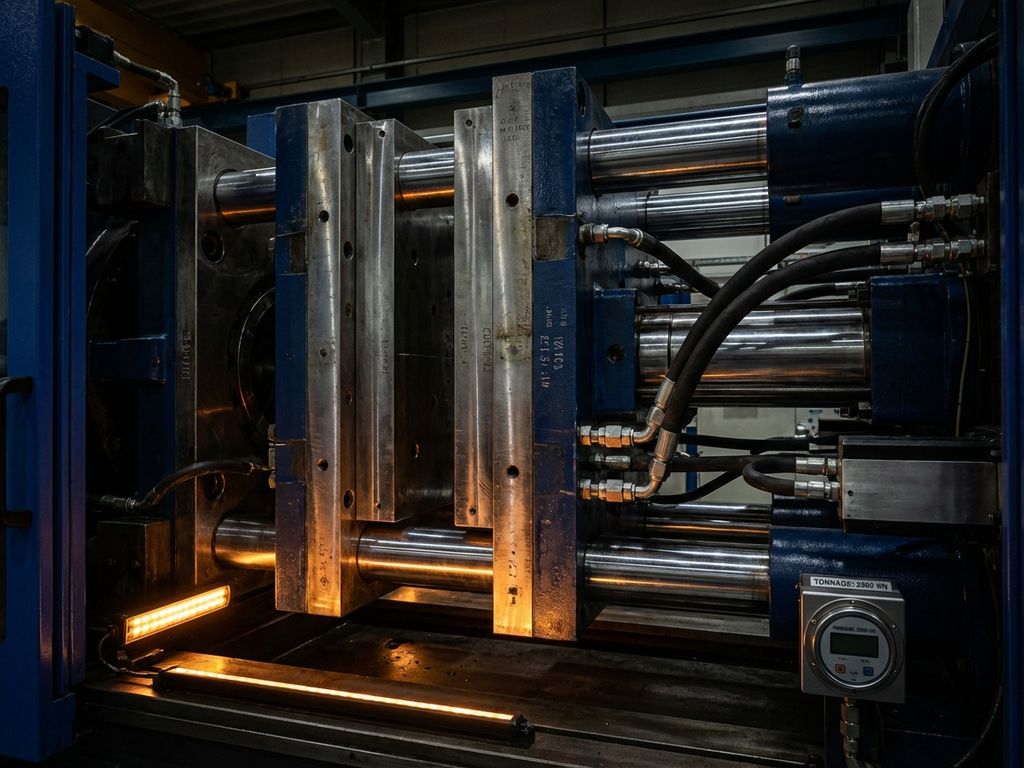
Injection molding tonnage requirements refer to the clamping force needed to keep molds closed during the injection process. This force is measured in tonnes and must exceed the pressure created by the injected plastic to prevent mold separation and defects. Proper tonnage calculation ensures quality parts while avoiding machine damage. Understanding tonnage requirements helps manufacturers select appropriate equipment and optimize production efficiency.
What determines injection molding tonnage requirements?
The projected surface area of the part determines the primary tonnage requirement for injection molding. This calculation multiplies the part’s projected area by the cavity pressure, typically ranging from 2–8 tonnes per square inch depending on material properties and wall thickness.
Material type plays a crucial role in tonnage calculations. High-viscosity materials like polycarbonate require greater injection pressures, increasing tonnage needs. Thin-walled parts demand higher pressures to fill completely, while thick sections may require additional tonnage to maintain proper packing pressure throughout the cooling cycle.
The number of cavities in your mold directly impacts tonnage requirements. Multi-cavity molds multiply the projected area calculation by the number of parts produced simultaneously. A four-cavity mold essentially quadruples your tonnage needs compared to a single-cavity design.
Mold design features such as runner systems, gate locations, and part geometry influence pressure distribution. Complex geometries with long flow paths require higher injection pressures, translating to increased clamping force requirements.
How do you calculate the right tonnage for your injection molding project?
Calculate tonnage by multiplying the total projected area of all cavities by the material-specific cavity pressure factor. Add a 10–20% safety margin to account for variations in material properties and processing conditions.
Begin by measuring the projected area of your part as viewed from the parting-line direction. This includes the main body plus any features like ribs or bosses that contribute to the overall footprint. Convert measurements to square inches for standard calculations.
Apply the appropriate pressure factor based on your material:
- Polyethylene and polypropylene: 2–4 tonnes per square inch
- ABS and polystyrene: 3–5 tonnes per square inch
- Nylon and polycarbonate: 4–8 tonnes per square inch
- Glass-filled materials: Add 20–30% to base calculations
Consider part wall thickness in your calculations. Thin walls below 1 mm typically require the higher end of pressure ranges, while thick sections above 3 mm may need additional packing pressure to prevent sink marks.
What happens when you use incorrect tonnage for injection molding?
Insufficient tonnage causes mold separation during injection, creating flash around part edges and potentially damaging mold surfaces. Excessive tonnage wastes energy, increases cycle times, and can damage molds through over-compression of parting-line surfaces.
Under-tonnage situations lead to several quality issues. Flash formation occurs when plastic escapes between mold halves, requiring additional finishing operations and causing material waste. Dimensional variations become common as inconsistent clamping allows slight mold movement during filling.
Part quality suffers significantly with inadequate clamping force. Short shots may occur if back pressure from mold separation prevents complete cavity filling. Surface defects and witness lines appear where plastic flow becomes disrupted by mold movement.
Over-tonnage creates different problems but equally costly outcomes. Excessive force crushes mold components, particularly fragile core pins or delicate surface textures. Machine wear accelerates as tie bars and platens experience unnecessary stress loads.
Energy consumption increases substantially with over-tonnage settings. Longer cycle times result from extended mold closing and opening phases under excessive force. Production efficiency drops while operating costs rise unnecessarily.
Which factors beyond part size affect injection molding tonnage needs?
Material flow characteristics significantly influence tonnage requirements beyond basic part dimensions. High-flow materials like polypropylene require less clamping force, while engineering plastics with poor flow properties need increased tonnage to maintain cavity pressure during filling and packing phases.
Processing temperature affects material viscosity and flow behavior. Higher melt temperatures reduce viscosity, potentially lowering required injection pressures and tonnage needs. However, some materials become more aggressive at elevated temperatures, requiring additional clamping force to prevent flash.
Injection speed settings directly impact pressure requirements. Faster injection rates create higher shear forces and cavity pressures, increasing tonnage demands. Slower filling may reduce peak pressures but extend packing time requirements.
Gate design and location influence pressure distribution throughout the cavity. Small gates create pressure drops that may require higher injection pressures. Multiple gates can reduce individual pressure requirements but complicate flow-balance calculations.
Cooling system efficiency affects packing-pressure duration. Well-designed cooling channels allow faster pressure release, while poor cooling extends the time high clamping forces must be maintained. This impacts both tonnage requirements and cycle-time optimization.
Mold temperature settings influence material flow and shrinkage characteristics. Higher mold temperatures improve flow but may increase shrinkage, requiring extended packing phases and sustained clamping pressure.
How do EAS change systems help optimize injection molding tonnage efficiency?
EAS change systems optimize tonnage efficiency by enabling rapid mold changes that allow manufacturers to match machine tonnage precisely to each job’s requirements. This eliminates the need to compromise on tonnage selection when multiple molds share the same machine.
Our quick mold change solutions provide several tonnage optimization benefits:
- Precise machine matching: Switch between molds requiring different tonnage levels on the same machine.
- Reduced setup complexity: Standardized clamping systems ensure consistent tonnage application across mold changes.
- Enhanced safety: Automated systems eliminate manual handling risks during tonnage-critical mold installations.
- Improved accuracy: Repeatable clamping positions ensure consistent tonnage distribution for optimal part quality.
- Energy efficiency: Match exact tonnage requirements without over-clamping waste.
The adaptive clamping systems maintain optimal tonnage throughout production runs while accommodating thermal expansion and material variations. This precision prevents both under-clamping defects and over-tonnage waste, maximizing production efficiency and part quality.
Contact our application engineering team to discover how EAS change systems can optimize your injection molding tonnage efficiency and reduce setup times for improved productivity.