

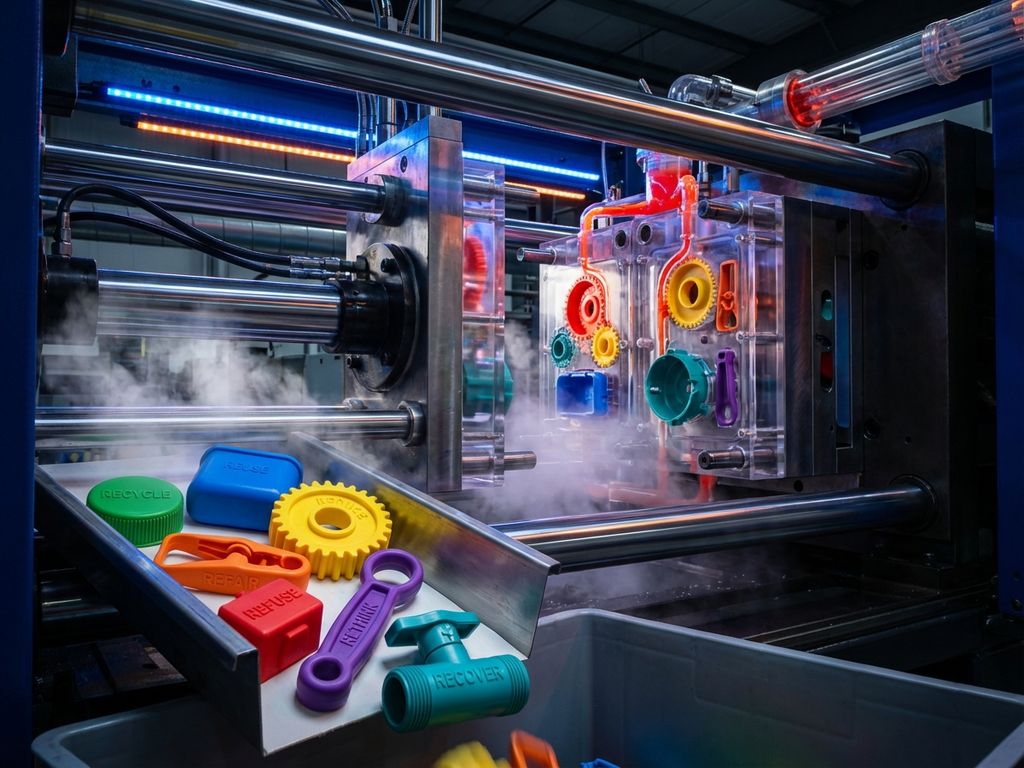
Manufacturing costs continue to squeeze profit margins across industries, making waste reduction a critical priority for injection moulding operations. The good news is that lean manufacturing principles, when properly applied to injection moulding processes, can deliver substantial cost savings while improving overall efficiency.
Lean manufacturing in injection moulding focuses on eliminating seven types of waste: overproduction, waiting, transport, inappropriate processing, unnecessary inventory, unnecessary motion, and defects. By systematically addressing these waste sources, manufacturers typically achieve cost reductions of between 20% and 35%.
This guide explores seven proven strategies that transform injection moulding operations from wasteful to efficient, helping you identify opportunities for immediate improvement and long-term competitive advantage.
Eliminate setup time waste with quick changeover systems
Setup times represent one of the largest sources of waste in injection moulding operations. Traditional mould changes can take anywhere from two to eight hours, during which expensive machinery sits idle and production targets fall behind schedule.
Single-Minute Exchange of Die (SMED) principles revolutionise this process by distinguishing between internal activities (requiring machine shutdown) and external activities (performed while the machine runs). The goal is to reduce internal setup time to under ten minutes.
Key SMED implementation steps include:
- Standardising mould mounting procedures
- Pre-positioning tools and materials
- Converting internal tasks to external ones
- Implementing quick-release mechanisms
- Training operators on streamlined procedures
Manufacturers implementing proper changeover systems typically reduce setup times by 75% or more, dramatically improving overall equipment effectiveness and enabling smaller batch production without efficiency penalties.
Reduce material waste through optimised process parameters
Material costs often represent 60–70% of total production expenses in injection moulding, making waste reduction in this area particularly impactful. Optimised process parameters directly influence material consumption and scrap rates.
Temperature control forms the foundation of efficient material usage. Maintaining precise barrel temperatures prevents material degradation while ensuring proper flow characteristics. Similarly, injection pressure optimisation reduces overpacking while ensuring complete cavity filling.
Cycle time reduction strategies include:
- Optimising cooling time through conformal cooling channels
- Balancing injection speed for different cavity sections
- Implementing scientific moulding principles
- Regular process validation and adjustment
Scrap elimination techniques focus on identifying the root causes of defects rather than simply sorting out bad parts. This proactive approach reduces material waste while improving overall quality consistency.
Streamline workflow with cellular manufacturing layouts
Traditional injection moulding facilities often suffer from excessive material transportation and complicated workflow patterns. Cellular manufacturing layouts group related processes together, creating efficient production cells that minimise waste.
Effective cellular layouts position injection moulding machines near secondary operations such as assembly, packaging, or quality inspection. This proximity reduces handling time and potential damage during transportation.
Work-in-progress inventory decreases significantly when cellular layouts enable continuous flow between operations. Rather than accumulating large batches between process steps, parts move smoothly through the production sequence.
Implementation considerations include:
- Grouping machines by product family rather than process type
- Positioning quality control stations within production cells
- Creating dedicated material storage areas for each cell
- Establishing clear visual management systems
Implement predictive maintenance to prevent costly downtime
Unplanned downtime costs injection moulding operations far more than just lost production time. Emergency repairs typically cost three to five times more than planned maintenance, while rushed repairs often compromise quality.
Predictive maintenance strategies use data collection and analysis to identify potential problems before they cause failures. Modern injection moulding machines generate extensive operational data that reveals patterns indicating developing issues.
Key monitoring parameters include:
- Hydraulic system pressure and temperature
- Screw wear indicators and injection consistency
- Heating element performance and temperature stability
- Mould condition and wear patterns
Systematic monitoring enables maintenance teams to schedule repairs during planned downtime, reducing both direct repair costs and production disruption. This approach also extends equipment life by addressing minor issues before they cause major damage.
Apply just-in-time production to minimise inventory waste
Excessive inventory ties up capital while creating storage costs and potential obsolescence issues. Just-in-time production aligns material deliveries and production schedules with actual customer demand.
Effective JIT implementation requires accurate demand forecasting and reliable supplier relationships. Raw material management becomes particularly critical, as reduced inventory buffers leave less margin for supply chain disruptions.
JIT strategies for injection moulding include:
- Establishing supplier partnerships with frequent deliveries
- Implementing kanban systems for material replenishment
- Coordinating production schedules with customer requirements
- Reducing batch sizes to match demand patterns
Finished goods optimisation focuses on producing what customers actually need rather than maximising machine utilisation through large batches. This customer-focused approach reduces carrying costs while improving service levels.
Optimise quality control to eliminate defect-related waste
Defects create multiple forms of waste: scrapped materials, rework time, delayed deliveries, and potential customer returns. Effective quality control systems prevent defects rather than simply detecting them after they occur.
Statistical process control methods track key quality parameters in real time, enabling immediate corrective action when processes drift outside acceptable limits. This proactive approach prevents the production of defective parts.
Root cause analysis techniques help identify the underlying causes of quality problems rather than addressing symptoms. Common tools include fishbone diagrams, five-why analysis, and statistical correlation studies.
Defect prevention strategies encompass:
- Design for manufacturability reviews
- Process capability studies
- Operator training and certification programmes
- Supplier quality agreements
These comprehensive applications of lean manufacturing principles across different industries demonstrate how systematic waste reduction transforms operational efficiency and profitability.
How EAS change systems accelerate lean manufacturing success
At EAS, we provide comprehensive quick mould change solutions that directly address the largest source of waste in injection moulding operations. Our products reduce mould changeover times from hours to minutes, enabling manufacturers to implement lean manufacturing principles effectively.
Our quick mould change systems deliver:
- Mould changes completed in under ten minutes
- Standardised changeover procedures that reduce operator variability
- Improved safety through automated clamping systems
- ROI typically achieved within 12–18 months
- Support for smaller batch production without efficiency penalties
From cost-effective individual components to complete turnkey systems, we help manufacturers achieve their lean manufacturing objectives through proven quick change technology.
Ready to eliminate setup waste from your injection moulding operations? Contact our application engineering team to discuss how our quick mould change systems can accelerate your lean manufacturing transformation and deliver measurable cost reductions.
