
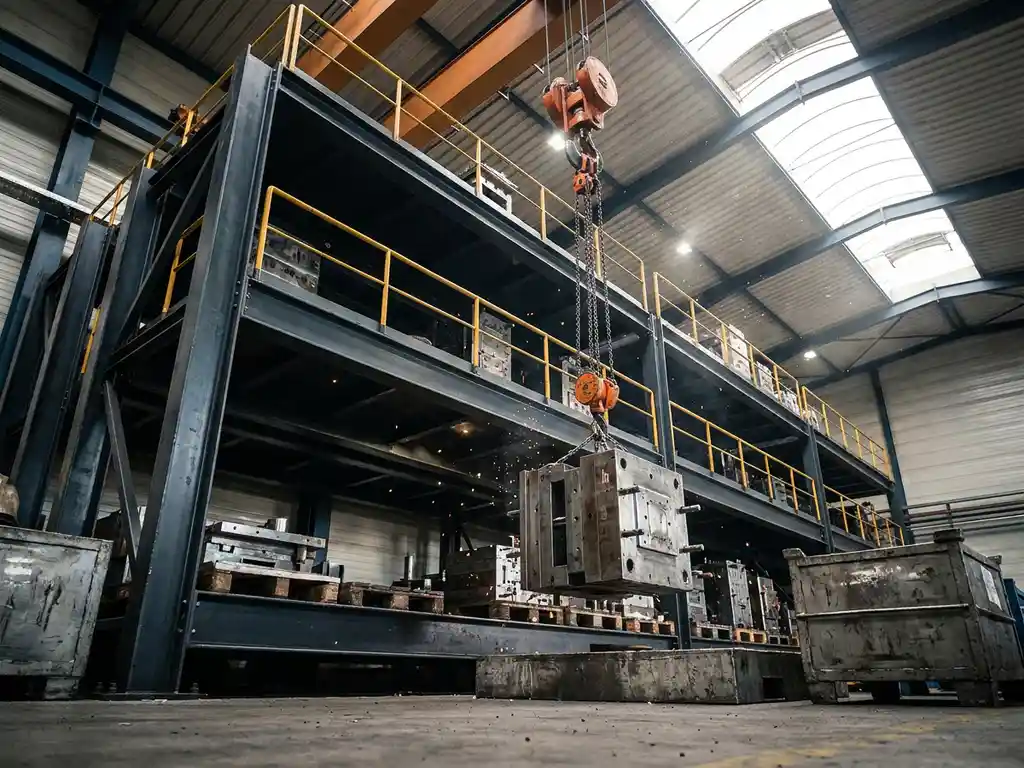
A mold storage rack integrates with overhead crane systems by providing structurally reinforced bays with open top access, clear load paths, and positioning features that align crane hooks and lifting beams directly above each stored mold. The rack design must account for crane span, hook height, and load capacity so that molds can be lifted in and out without obstruction or repositioning delays. The sections below explore every dimension of this integration, from crane access geometry to safety standards and changeover benefits.
What crane access requirements does a mold storage rack need to meet?
A mold storage rack must provide unobstructed vertical access above each storage bay so that an overhead crane can lower and raise molds freely. This means the rack cannot have horizontal cross-members, covers, or structural elements that block the lift path. The rack height, bay width, and aisle clearance must all align with the crane’s hook height and the dimensions of the lifting beam or spreader bar in use.
Beyond geometry, the rack must be rated to handle dynamic loading. When a crane places a mold into a bay, there is a brief impact load as the mold settles onto the support rails or cradles. The rack structure needs to absorb this without deflecting in a way that shifts the mold out of position. Rack manufacturers typically specify a dynamic load factor, often expressed as a multiple of the static mold weight, to account for this.
Aisle width is equally important. The crane bridge travels along a fixed runway, so the rack layout must position each storage bay within the crane’s working envelope. If bays are placed outside the crane’s lateral reach, operators must use secondary handling equipment, which defeats the purpose of integration. Planning the rack layout alongside the crane specification is therefore essential from the earliest design stage.
How does a mold storage rack guide crane positioning during mold retrieval?
A mold storage rack guides crane positioning through physical locating features such as tapered entry guides, end stops, and bay numbering systems that help operators align the crane hook precisely above the correct mold. These features reduce the trial-and-error movement that slows retrieval and increases the risk of collisions between the lifted mold and adjacent rack structure.
More advanced racking systems incorporate laser alignment markers or reflective targets mounted at bay entry points. When paired with a crane equipped with a positioning display or semi-automated travel control, these targets allow the crane to stop within millimeters of the correct position. This level of precision matters most in high-density storage configurations where molds are stored close together and lateral clearance is tight.
Bay identification systems, whether painted numbers, barcode labels, or RFID tags, also contribute to accurate positioning by connecting the physical rack location to a mold management database. An operator who knows exactly which bay holds the required mold can direct the crane there without searching, cutting retrieval time significantly.
What types of mold storage racks work best with automated crane systems?
Open-frame cantilever racks and drive-in racking systems with wide-span bays work best with automated overhead crane systems because they provide the clear vertical access and predictable load positions that automation depends on. Closed shelving or drawer-style storage is incompatible with overhead crane retrieval because the crane cannot reach molds stored inside enclosed structures.
For fully automated crane systems, the ideal rack type presents each mold at a consistent height and lateral position every time. This is why many automated mold storage installations use fixed-position cradle racks where each bay has a dedicated cradle shaped to the mold’s base. The cradle eliminates positional variation, so the automated crane can follow a repeatable program without needing sensor feedback to compensate for mold placement inconsistencies.
Modular rack systems that can be reconfigured as the mold inventory changes are also popular because they allow the storage layout to evolve without replacing the entire crane integration. Provided the bay pitch and load height remain consistent across reconfigurations, the crane programming requires only minor updates rather than a full recommissioning. To see the range of solutions available for different storage configurations, explore our mold change products.
How does mold weight and size affect rack and crane system design?
Mold weight and size directly determine the structural rating of the storage rack, the capacity class of the overhead crane, and the type of lifting attachment required. A rack designed for molds weighing up to two tonnes will use significantly heavier uprights, base plates, and bay supports than one designed for smaller tooling, and the crane must be specified to lift the heaviest mold in the inventory with a safe working load margin.
Mold footprint affects bay spacing. Wider molds require wider bays, which reduces the number of molds that can be stored within a given floor area. Taller molds require either a higher rack or a lower storage position, both of which affect how much hook height the crane needs to clear the mold during extraction. These constraints must be resolved during the layout design phase, not after installation.
Very large or asymmetric molds often require custom lifting beams or spreader frames to distribute the crane load evenly across multiple lift points. The rack design must accommodate the footprint of these lifting attachments as well as the mold itself, since a spreader bar wider than the rack bay opening cannot be lowered into position. Coordinating lifting attachment design with rack bay dimensions is a detail that is easy to overlook and expensive to correct after the fact.
What safety standards govern mold rack and overhead crane integration?
Mold storage rack and overhead crane integration is governed by a combination of standards covering structural racking, lifting equipment, and workplace safety. In Europe, EN 15635 covers steel static storage systems and specifies inspection and load marking requirements for industrial racking. Overhead cranes fall under the Machinery Directive and EN 15011, which sets design and safety requirements for bridge and gantry cranes. Both sets of requirements apply simultaneously when the two systems work together.
Load marking is a specific requirement that affects both systems. Every rack bay must display its maximum permissible load, and the crane must display its safe working load. Operators must be trained to cross-reference these limits before every lift. If a mold’s weight is unknown or unverified, it must be weighed before crane handling begins.
Rack anchoring to the floor is mandatory in most jurisdictions because an unanchored rack can tip under eccentric loading, particularly when a crane places a heavy mold into an upper bay. Seismic requirements add additional anchoring demands in regions with earthquake risk. Regular rack inspections, as required by EN 15635, must also verify that crane operations have not caused structural damage to uprights or bay supports over time.
How does mold rack integration with cranes reduce changeover time?
Mold rack integration with overhead cranes reduces changeover time by eliminating the manual search, floor-level handling, and repositioning steps that consume most of the time between production runs. When a mold is stored at a known location in a rack that is directly accessible by crane, retrieval becomes a single, direct operation rather than a multi-step process involving forklifts, floor space management, and manual alignment.
The time savings compound when the rack is positioned close to the injection molding or stamping machine it serves. A crane that travels a short distance from the storage rack to the machine platen can complete a mold exchange in a fraction of the time required when molds are stored in a remote warehouse and transported by forklift. Facility layout planning that minimizes crane travel distance is therefore one of the most impactful decisions in changeover reduction. Understanding how these systems apply across different industries can help identify further efficiency gains — see our overview of mold change applications for more detail.
Structured storage also reduces the risk of selecting the wrong mold, which causes delays when the mistake is discovered at the machine. When each rack bay is clearly identified and linked to a mold management system, operators retrieve the correct mold on the first attempt, and the crane cycle begins immediately rather than after a search and correction sequence.
How EAS Change Systems help with mold storage and crane integration
We design and supply complete quick mold change solutions that address every element of crane-compatible mold storage, from the structural racking layout to the clamping systems that secure molds once they reach the machine. Our approach covers the full workflow so that storage, transport, and changeover work as a single coordinated system rather than a collection of separate components. Specifically, we help with:
- Application engineering: We assess your crane specifications, mold inventory, and floor layout to design a racking configuration that fits within the crane’s working envelope and meets your throughput targets.
- Mold change tables and transportation vehicles: We supply intermediate handling equipment that bridges the gap between crane delivery and machine-side positioning, keeping molds moving safely at every stage.
- Mold maintenance solutions: Through our Tool Care program and inspection units, we support mold condition management so that molds entering and leaving storage are tracked and maintained in optimal condition.
- System installation and commissioning: Our teams install and commission the complete system, verifying crane clearances, load ratings, and safety compliance before handover.
- ROI calculations: We provide documented return-on-investment analysis so you can quantify the changeover time savings and justify the investment to stakeholders.
If you are planning a new mold storage installation or upgrading an existing setup to work with an overhead crane system, contact EAS Change Systems today to discuss your requirements with one of our application engineers.