

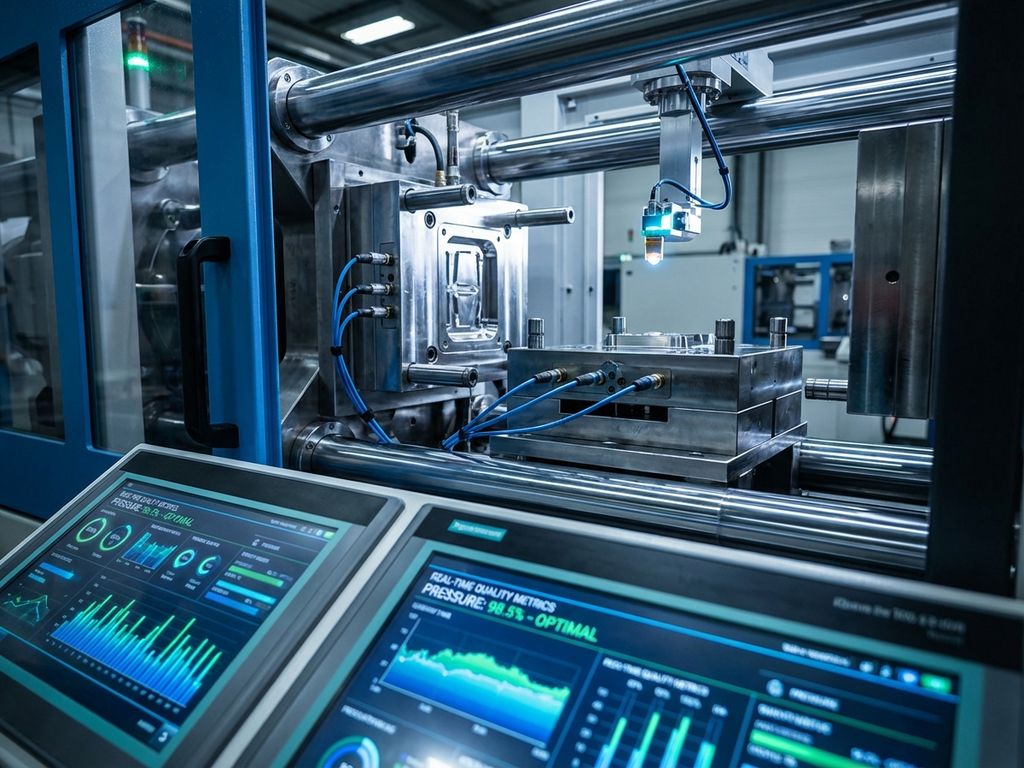
Manufacturing defects in injection molding can devastate production schedules and profit margins. Traditional quality control methods often catch problems too late, leading to costly scrap, rework, and customer complaints. Modern injection molding quality control systems offer a revolutionary approach to preventing defects before they occur.
Advanced quality control technology transforms how manufacturers monitor and maintain product quality throughout the injection molding process. These systems combine real-time monitoring, automated inspection, and intelligent feedback loops to catch potential issues at the earliest possible stage. The result is dramatically improved product consistency, reduced waste, and enhanced operational efficiency.
Understanding how to implement and leverage these advanced systems can be the difference between struggling with quality issues and achieving manufacturing excellence. Let’s explore why traditional methods fall short and how modern solutions address these critical challenges.
Why traditional quality control fails in injection molding
Manual inspection methods create significant bottlenecks in injection molding operations. Operators can only sample a fraction of produced parts, leaving substantial gaps in quality coverage. Human inspectors naturally experience fatigue, leading to inconsistent defect detection throughout production runs.
Traditional quality control typically occurs after parts are produced, creating costly time delays between defect occurrence and detection. By the time quality issues are identified, hundreds or thousands of defective parts may have already been manufactured. This reactive approach generates substantial scrap costs and requires extensive rework.
Manual measurement tools and visual inspections struggle with complex geometries and tight tolerances common in modern injection molding. Subjective quality assessments vary between operators, creating inconsistency in quality standards. These limitations become particularly problematic when dealing with high-volume production or intricate part designs requiring precise dimensional accuracy.
Essential components of advanced quality control systems
Modern injection molding quality control systems integrate multiple sophisticated technologies to provide comprehensive monitoring capabilities. Vision systems use high-resolution cameras and advanced image processing algorithms to detect surface defects, dimensional variations, and assembly errors with microscopic precision.
Sensor networks monitor critical process parameters throughout the injection molding cycle. Temperature sensors track melt and mold temperatures, while pressure sensors monitor injection and holding pressures. Flow sensors measure material flow rates, providing real-time feedback on process consistency.
Data analytics platforms collect and analyze information from all monitoring components, identifying patterns and trends that indicate potential quality issues. Machine learning algorithms continuously improve defect detection accuracy by learning from historical data and operator feedback.
Integration capabilities allow quality control systems to communicate with injection molding machines, automatically adjusting process parameters when deviations are detected. This closed-loop feedback creates a self-correcting system that maintains optimal quality conditions.
How automated quality systems prevent injection molding defects
Advanced quality control systems excel at preventing warping by continuously monitoring cooling patterns and cycle times. Temperature sensors detect uneven cooling that leads to internal stresses, while automated systems adjust cooling parameters to maintain uniform temperature distribution throughout the part.
Sink marks and surface defects are prevented through real-time monitoring of injection pressure and holding time. Automated feedback systems adjust these parameters when sensors detect conditions that typically produce surface imperfections, maintaining consistent part appearance and structural integrity.
Flash prevention relies on precise monitoring of clamping force and injection pressure. When systems detect pressure spikes or insufficient clamping force, they immediately adjust parameters to prevent material from escaping the mold cavity. This real-time correction eliminates flash formation before it occurs.
Short shots are prevented through comprehensive monitoring of material flow, injection speed, and fill patterns. Vision systems can detect incomplete fills immediately after part ejection, while process monitoring identifies root causes such as insufficient injection pressure or blocked flow channels.
Implementing quality control systems in existing production lines
Successful implementation begins with a thorough assessment of current quality challenges and production requirements. Manufacturers must evaluate existing equipment compatibility, available space for new components, and integration requirements with current control systems.
Installation planning requires careful consideration of sensor placement, camera positioning, and data communication infrastructure. Minimal production disruption is achieved through phased implementation, starting with pilot installations on select machines before expanding to full production lines.
Operator training plays a crucial role in successful system adoption. Staff must understand new monitoring displays, alarm systems, and response procedures. Comprehensive training programs ensure operators can effectively utilize advanced quality control capabilities while maintaining production efficiency.
Change management strategies help overcome resistance to new technology by demonstrating clear benefits and involving operators in the implementation process. Regular feedback sessions and continuous improvement initiatives maintain momentum and identify opportunities for system optimization.
How EAS change systems enhance injection molding quality control
We provide quick mold change solutions that significantly improve quality control consistency by eliminating setup variability between mold changes. Our systems ensure precise, repeatable mold positioning and clamping, maintaining consistent process parameters that are critical for quality control system accuracy.
Our comprehensive quick mold change solutions offer several quality control advantages:
- Reduced mold changeover time from hours to minutes, minimizing quality validation periods
- Consistent clamping forces and mold alignment for repeatable process conditions
- Integrated coupling systems that maintain utility connections and process monitoring continuity
- Standardized setup procedures that eliminate human error during mold changes
- Enhanced process stability through precise mold positioning and secure clamping
These improvements directly support advanced quality control systems by providing the stable, consistent foundation necessary for accurate monitoring and defect prevention. When combined with automated quality control technology, our manufacturing solutions create a comprehensive approach for achieving manufacturing excellence.
Ready to enhance your injection molding quality control capabilities? Contact us today to learn how our quick mold change systems can improve your production consistency and quality outcomes.