

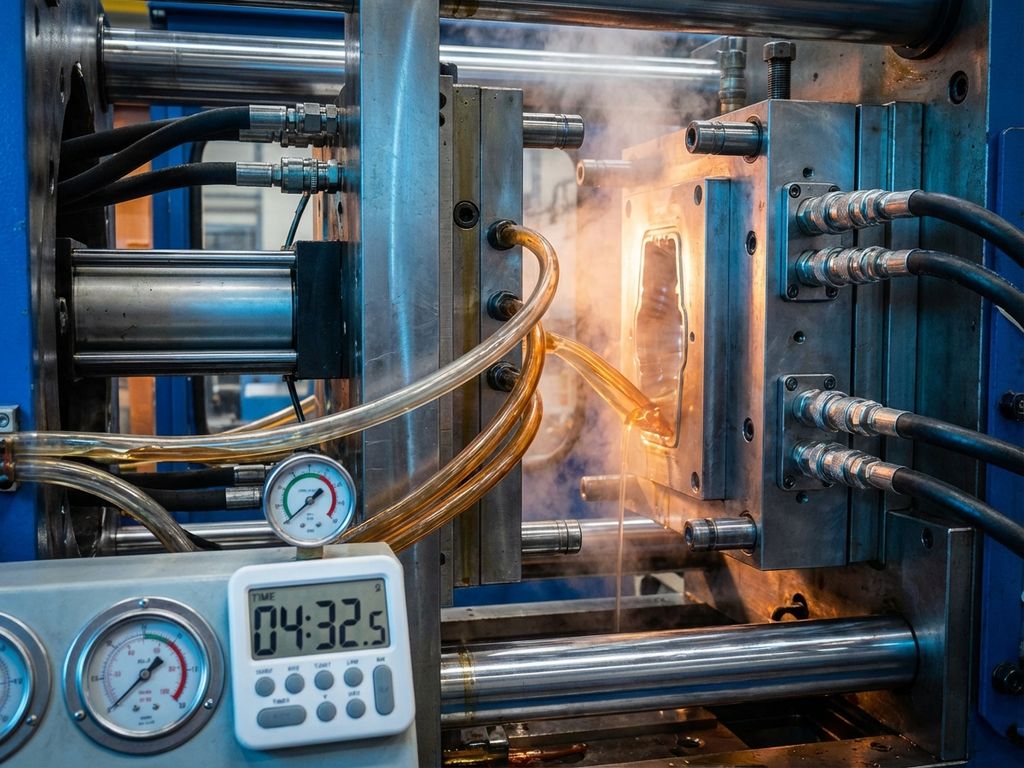
Injection mold cycle time is the total duration needed to complete one full molding cycle, from mold closing to part ejection. It includes injection time, cooling time, packing time, and mold opening and closing operations. Calculating cycle time accurately helps manufacturers optimize production efficiency and identify bottlenecks in their molding processes.
What factors determine injection mold cycle time?
Several key variables directly influence injection mold cycle time, with cooling time typically representing 60–80% of the total cycle duration. Material properties play a crucial role, as different plastics require varying temperatures and cooling periods to solidify properly.
Part geometry significantly affects cycle time through wall thickness, complexity, and surface area. Thicker sections require longer cooling periods, while intricate geometries may need slower injection speeds to fill properly. The cooling system design, including channel placement and cooling medium temperature, directly impacts how quickly parts reach ejection temperature.
Machine parameters such as injection pressure, speed, and temperature settings must be optimized for each application. Higher injection pressures can reduce filling time but may require longer packing phases. Mold design elements, including gate size, runner systems, and venting, also influence cycle efficiency.
Environmental factors like ambient temperature and humidity can affect material behavior and cooling rates. Process consistency depends on maintaining stable conditions throughout production runs.
How do you calculate the total injection molding cycle time?
Total cycle time equals the sum of injection time, packing time, cooling time, and mold open/close time. The basic formula is: Cycle Time = Injection + Packing + Cooling + Mold Movement. Each component must be measured accurately to optimize overall efficiency.
Injection time depends on shot volume, injection speed, and flow rate through gates and runners. Calculate this by dividing the total shot volume by the volumetric flow rate. Packing time maintains pressure to compensate for material shrinkage as it cools, typically lasting 5–15 seconds depending on part thickness.
Cooling time calculation requires knowing the thickest section of the part and material properties. Use the formula: Cooling Time = (Wall Thickness² / Material Diffusivity) × ln(Temperature Difference Ratio). This represents the largest portion of most cycles.
Mold open/close time includes ejection, part removal, and mold closing. Modern machines complete this in 3–8 seconds for standard applications. Add any additional operations, such as insert placement or part inspection, to obtain the total cycle time.
What’s the difference between cycle time and setup time in injection molding?
Cycle time refers to the production duration for each individual part during continuous operation, while setup time encompasses mold changeover activities between different production runs. These represent entirely different aspects of manufacturing efficiency and require separate optimization strategies.
Production cycle time typically ranges from 15 seconds to several minutes per part, depending on size and complexity. This time directly affects hourly production rates and unit costs. Reducing cycle time by even a few seconds can significantly impact daily output volumes.
Setup time involves mold installation, machine parameter adjustments, material changes, and first-article approval. Traditional changeovers can take 2–8 hours depending on complexity and preparation. This downtime affects overall equipment effectiveness and production scheduling flexibility.
Both times impact total manufacturing costs differently. Shorter cycle times increase throughput for long production runs, while reduced setup times enable smaller batch sizes and improved responsiveness to customer demands. Manufacturers must balance optimization efforts between both areas.
How can manufacturers reduce injection mold cycle times effectively?
Effective cycle time reduction focuses primarily on cooling system optimization and process parameter adjustments. Improving heat transfer through enhanced cooling channel design, higher flow rates, and lower coolant temperatures can reduce cooling time by 20–40% in many applications.
Material selection impacts cycle duration significantly. Choose grades with faster crystallization rates, better flow properties, and lower processing temperatures when possible. Consider additives that improve thermal conductivity or reduce shrinkage to minimize packing time requirements.
Mold design modifications include optimizing gate locations, improving venting, and reducing runner volumes. Better heat transfer through conformal cooling channels or improved steel grades can dramatically reduce cooling requirements. Proper gate sizing ensures efficient filling without excessive injection times.
Process parameter optimization involves finding the ideal balance between injection speed, pressure, and temperature. Scientific molding approaches use data-driven methods to identify optimal settings. Regular maintenance ensures consistent performance and prevents gradual cycle time increases due to wear or contamination.
Equipment upgrades to faster-acting machines, improved control systems, or better auxiliary equipment can provide additional reductions. However, focus on process improvements before considering capital investments for maximum return on investment.
How EAS change systems help with injection mold cycle time optimization
EAS change systems significantly reduce overall production time by minimizing mold changeover periods from hours to minutes. Our quick mold change solutions eliminate traditional setup bottlenecks, allowing manufacturers to focus on optimizing actual production cycle times rather than losing efficiency during changeovers.
Our comprehensive injection molding optimization solutions include:
- Adaptive clamping systems that reduce mold installation time by up to 90%
- Multi-coupler systems for rapid utility connections (cooling, heating, ejector pins)
- Automated mold handling equipment for consistent, safe changeovers
- Precision alignment systems ensuring optimal mold positioning every time
- Integration with existing machine controls for seamless operation
By reducing setup times from several hours to under 10 minutes, manufacturers can run smaller batches economically while maintaining high overall equipment effectiveness. This flexibility enables better response to customer demands and reduces inventory carrying costs.
Ready to optimize your injection molding cycle times? Contact us today to discuss how our quick change systems can transform your production efficiency and reduce both setup and operational costs.
