
Every manufacturing facility faces the inevitable question: When should aging injection molding equipment be repaired rather than replaced? This decision directly affects production downtime and requires careful analysis of multiple factors. Understanding the warning signs, hidden costs, and financial implications helps manufacturers make informed choices that optimize both operational efficiency and long-term profitability.
The right decision balances immediate repair costs against future reliability, efficiency gains, and technological advantages. Modern injection molding equipment offers significant improvements in speed, precision, and automation that can transform production capabilities. Let’s explore the key considerations that guide this critical investment decision.
How Do You Know When Injection Molding Equipment Is Too Old?
Injection molding equipment typically shows clear warning signs as it approaches the end of its useful life. Key indicators include frequent breakdowns that result in more than 20% downtime per month, difficulty sourcing replacement parts, declining product quality despite proper maintenance, and energy consumption that exceeds modern standards by 30% or more.
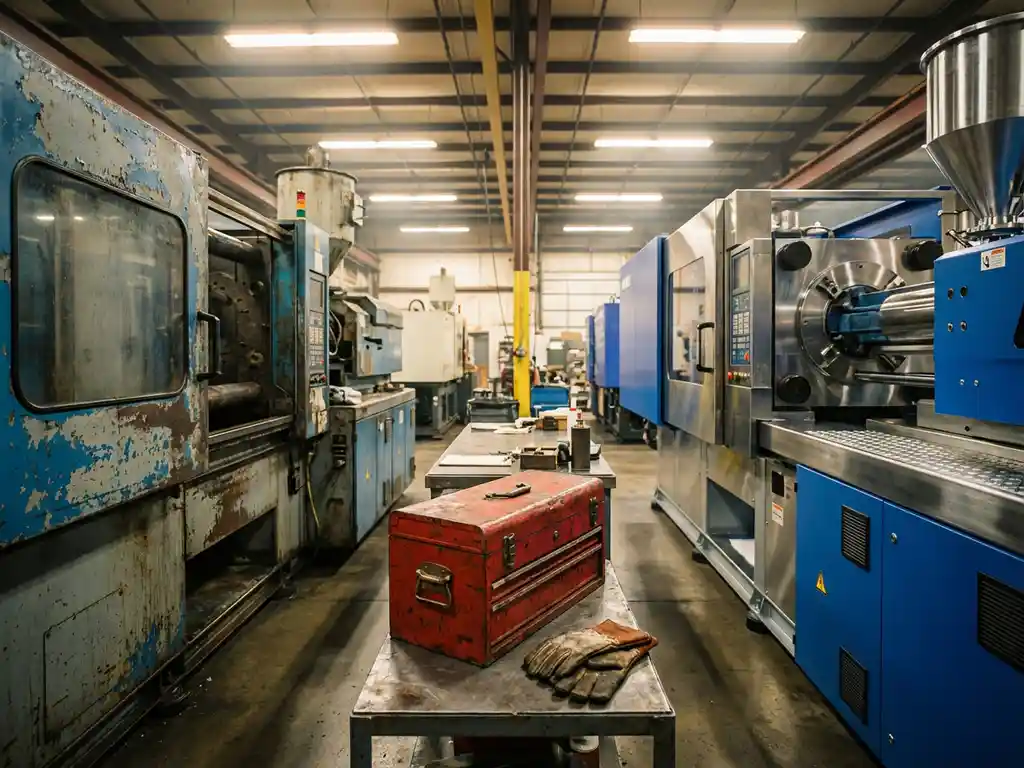
Age alone isn’t the determining factor, but equipment more than 15–20 years old often lacks modern safety features, precision controls, and energy-efficiency standards. Older machines may struggle to maintain consistent cycle times, leading to production bottlenecks and quality issues. Additionally, outdated control systems can make integration with modern manufacturing execution systems nearly impossible.
Consider replacement when injection molding troubleshooting becomes a weekly occurrence rather than an occasional maintenance task. If your maintenance team spends more time fixing equipment than performing preventive care, the machine has likely exceeded its optimal service life. Rising scrap rates, inconsistent part dimensions, and customer quality complaints also signal that equipment performance has degraded beyond acceptable levels.
What Are the Hidden Costs of Keeping Old Injection Molding Machines?
The hidden costs of maintaining aging injection molding equipment often exceed the obvious repair expenses. These include increased energy consumption, higher scrap rates, longer setup times, reduced production capacity, and the opportunity cost of efficiency gains available with modern equipment.
Energy costs represent a significant hidden expense. Older machines typically consume 40–60% more electricity than modern alternatives due to inefficient hydraulic systems, outdated heating elements, and poor insulation. Over a machine’s operating life, energy costs can equal or exceed the original purchase price.
Production inefficiencies compound these costs through longer cycle times, frequent quality issues, and extended changeover periods. Older equipment often requires manual adjustments that modern machines handle automatically, increasing labor costs and the potential for human error. Emergency repairs during production runs create costly downtime that ripples through the entire production schedule, affecting delivery commitments and customer relationships.
Maintenance costs escalate as parts become scarce and specialized technicians become harder to find. Custom fabrication of obsolete components can cost three to five times more than standard replacement parts for newer equipment.
When Does Repairing Injection Molding Equipment Make Financial Sense?
Repairing injection molding equipment makes financial sense when the total repair cost is less than 50% of the replacement value, the machine is under 10 years old, and parts remain readily available from the manufacturer. Additionally, repairs are justified when the equipment meets current production requirements and no immediate capacity expansion is needed.
Base the repair-versus-replace calculation on remaining useful life. If a machine has five or more years of productive service remaining and the repair addresses the root cause rather than the symptoms, repair often proves more economical. However, evaluate whether the repair truly solves the problem or merely delays inevitable replacement.
Repairs can also make sense for specialized equipment with unique capabilities that aren’t easily replicated in newer models. Some older machines excel at specific applications or have been customized for particular products, making replacement more complex and expensive than straightforward repairs.
The availability of skilled technicians and replacement parts significantly influences repair viability. If your maintenance team understands the equipment thoroughly and parts remain accessible at reasonable costs, repairs can extend useful life considerably while you plan for eventual replacement.
How Much Does It Cost to Replace Injection Molding Equipment?
Replacement costs for injection molding equipment range from $50,000 for small machines to more than $500,000 for large, high-precision units. The total investment includes the machine price, installation, training, tooling modifications, and potential production-line reconfiguration to accommodate new equipment dimensions and capabilities.
Beyond the machine cost, factor in installation expenses that typically add 10–15% to the total investment. This includes electrical work, utility connections, foundation preparation, and integration with existing systems. Training costs for operators and maintenance staff can range from $5,000 to $20,000, depending on equipment complexity and team size.
Consider financing options that can make replacement more attractive than continued repairs. Many manufacturers offer lease programs or financing arrangements that spread costs over several years while providing immediate productivity benefits. Calculate the total cost of ownership over the equipment’s expected life, including energy savings, reduced maintenance, and improved efficiency.
Don’t overlook the value of trade-in programs or equipment buyback options that can offset replacement costs. Some manufacturers offer significant credits for older equipment, even if it isn’t functioning optimally.
What Modern Features Should You Look for in New Injection Molding Equipment?
Modern injection molding equipment should include advanced process-control systems, energy-efficient servo-electric drives, predictive maintenance capabilities, Industry 4.0 connectivity, and integrated quality-monitoring systems. These features significantly improve production consistency, reduce energy consumption, and enable proactive maintenance scheduling.
Energy efficiency is one of the most valuable modern features. Servo-electric drives consume 30–50% less energy than traditional hydraulic systems while providing superior precision and repeatability. Variable-frequency drives and optimized heating systems further reduce operating costs while improving temperature-control accuracy.
Smart connectivity features enable remote monitoring, predictive analytics, and integration with manufacturing execution systems. These capabilities provide real-time production data, identify potential issues before failures occur, and optimize production scheduling across multiple machines.
Look for equipment with advanced safety features, including light curtains, pressure-sensitive mats, and automatic door-locking systems. Modern machines also offer faster setup through quick-change tooling systems, automated parameter adjustment, and recipe-management systems that reduce changeover times and human error.
How EAS Change Systems Helps Reduce Production Downtime
We specialize in quick mold change and quick die change solutions that dramatically reduce setup times and production downtime, whether you repair or replace your injection molding equipment. Our advanced products transform changeovers from hours to minutes, maximizing the value of your equipment investment.
Our comprehensive solutions include:
- Adaptive clamping systems that eliminate manual mold positioning and securing
- Multi-coupler systems that connect all utilities simultaneously with a single action
- Mold change tables and transportation vehicles for safe, efficient tool handling
- Complete turnkey systems designed specifically for your production requirements
- ROI calculations and application engineering to optimize your changeover processes
Whether you’re extending the life of existing equipment or investing in new machines, our quick-change systems help you maximize production efficiency and minimize downtime. Contact us today to learn how our proven solutions can transform your injection molding operations and deliver measurable returns on your equipment investments.