
An inadequate mold storage rack shows clear warning signs: structural damage to the rack itself, difficulty retrieving molds efficiently, repeated mold damage, and a system that simply cannot handle the weight or dimensional variety of your tooling inventory. These problems compound over time, directly affecting production scheduling and changeover performance. The sections below address each warning sign in detail so you can assess your current setup with confidence.
How do damaged or deformed rack structures signal a storage problem?
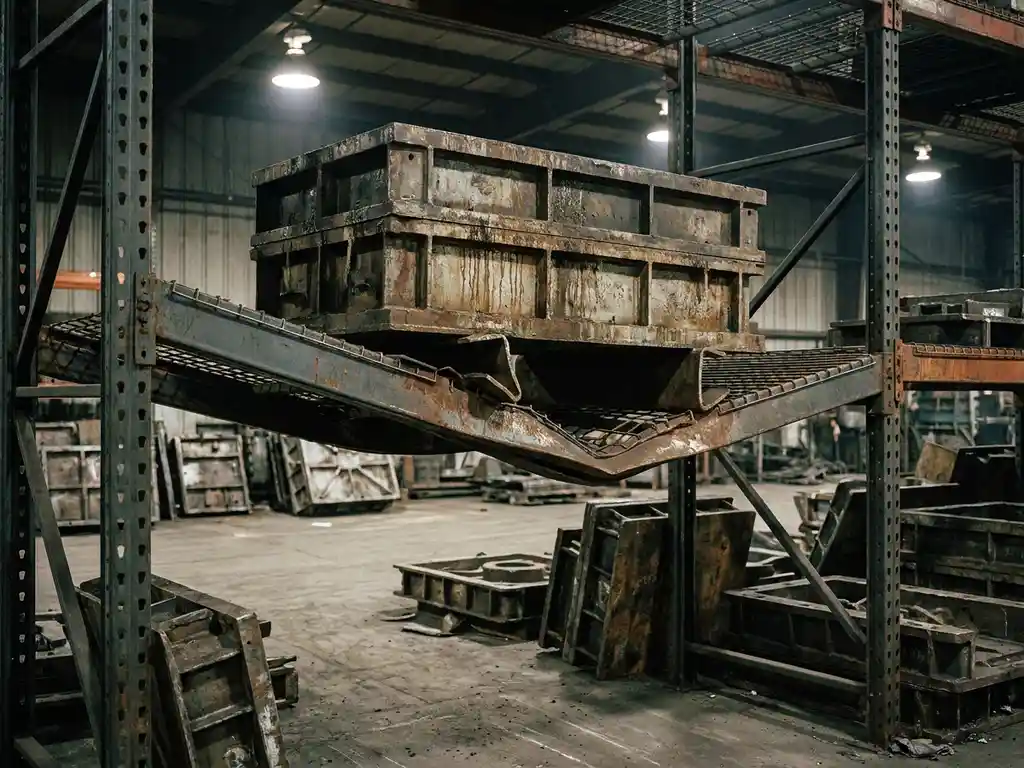
Visible damage to a racking system is one of the clearest indicators that your mold storage rack is no longer fit for purpose. Bent uprights, warped beams, cracked welds, and sagging shelf levels all point to a structure that has been pushed beyond its design limits. When a storage rack shows physical deformation, it is no longer providing reliable, predictable support for heavy tooling.
Pay close attention to the following warning signs during routine inspections:
- Uprights or columns that lean or bow under load
- Beam connectors that have partially disengaged or show stress fractures
- Rust or corrosion that has compromised the structural cross-section
- Floor anchors that have worked loose or are missing entirely
- Rack levels that are no longer level, causing molds to shift position
Any one of these conditions creates a safety risk for operators and a real threat to the molds stored on the system. In an industrial environment where molds can weigh several tonnes, a structural failure is not a minor inconvenience. It is a serious incident waiting to happen. If your inspection reveals more than superficial surface wear, treat it as an urgent signal to evaluate the entire racking system.
What does slow or difficult mold retrieval tell you about your racking system?
When retrieving a mold from storage takes significantly longer than it should, the racking system is almost certainly contributing to the problem. A well-designed mold storage rack gives operators clear access to each tool, logical organisation by size or production family, and enough clearance to move molds safely with handling equipment. When those conditions are absent, retrieval slows down and errors increase.
Slow retrieval is often caused by overcrowded bays where molds block each other, unclear labelling that forces operators to search manually, or rack configurations that were never designed around the actual dimensions of the molds being stored. Over time, teams develop workarounds that add minutes to every changeover. Those minutes add up across a full production week and represent genuine lost capacity.
If your team regularly has to reposition other molds to reach the one they need, or if retrieval requires multiple people where one should suffice, the rack layout is working against your operation rather than supporting it. Exploring purpose-built mold storage and handling products is often the most effective way to resolve these inefficiencies at their root.
Why does mold damage increase when storage capacity is exceeded?
Mold damage rises sharply when a storage rack is operating beyond its intended capacity. When space runs out, molds get stacked improperly, placed on makeshift supports, or crowded into positions where they contact each other. Precision tooling is not designed to absorb incidental knocks, and even minor surface damage to a mold can affect part quality or require costly repair.
Overcapacity storage also puts pressure on operators to move quickly, which increases the likelihood of handling accidents. A mold that is difficult to access because the rack is full is more likely to be dropped, dragged, or bumped during retrieval. The cost of repairing or replacing a damaged mold is almost always far greater than the cost of investing in adequate storage infrastructure.
If your maintenance records show a pattern of mold damage that correlates with storage handling rather than production use, overcapacity racking is a strong candidate for the root cause.
What are the signs that your rack system can’t handle mold weight or size variations?
A racking system that cannot accommodate the weight or dimensional range of your mold inventory will show its limitations through physical strain and operational compromise. Signs include beams that deflect visibly under load, rack levels that have been informally reinforced with additional supports, and molds that overhang their designated positions because the rack was not sized for them.
Mold inventories evolve. New tooling is often larger or heavier than the equipment the rack was originally specified for, and a system that was adequate five years ago may now be systematically undersized. Key indicators include:
- Molds that cannot be placed on any level without exceeding the rated load
- Tools that are too wide or deep to fit within the rack bay dimensions
- Operators avoiding certain rack positions because they are known to be unstable
- Informal workarounds such as storing heavy molds on the floor because no rack level can take the weight
A racking system should be specified to the heaviest and largest mold in your inventory, with a safety margin built in. If your current system was not designed with that principle, it is likely a limiting factor on your operational flexibility. Reviewing the full range of mold handling applications available can help identify where a better-matched solution would deliver the most impact.
How does poor mold storage affect production scheduling and changeover times?
Inefficient mold storage directly extends changeover times and introduces unpredictability into production scheduling. When a mold cannot be located quickly, retrieved cleanly, and transported to the press without difficulty, every minute of that process is added to your effective changeover window. In high-mix production environments, this friction accumulates into significant lost production time across a shift or week.
Poor storage organisation also makes it harder to pre-stage molds ahead of a scheduled changeover. If the next mold in the production sequence cannot be identified and positioned in advance, the press sits idle while the team retrieves and prepares the tool. This is a direct hit to overall equipment effectiveness.
Beyond the time cost, unreliable storage creates scheduling uncertainty. Planners cannot commit to tight changeover windows if they know that mold retrieval is unpredictable. The result is conservative scheduling that underutilises press capacity, or optimistic scheduling that regularly fails to meet its targets.
When should you replace your mold storage racking system entirely?
A mold storage rack should be replaced entirely when repairs can no longer restore structural integrity, when the system’s capacity or configuration no longer matches the mold inventory, or when the cumulative cost of workarounds and mold damage exceeds the investment in a purpose-built replacement. Partial repairs on a fundamentally undersized or damaged structure rarely deliver lasting improvement.
Consider full replacement when:
- Structural inspections reveal damage that cannot be safely repaired in place
- The rack was not designed for current mold weights and cannot be safely upgraded
- The layout prevents efficient retrieval regardless of how molds are organised within it
- Mold damage attributable to storage handling is a recurring cost
- Changeover times are being extended by storage-related delays on a regular basis
In 2026, the business case for purpose-built mold storage is stronger than ever. Press capacity is valuable, skilled operators are a limited resource, and mold repair costs continue to rise. A storage system that undermines all three of those factors is not a neutral asset. It is an active cost driver.
How EAS Change Systems Supports Better Mold Storage and Maintenance
At EAS Change Systems, we understand that mold storage is not just a logistics question. It is directly connected to mold condition, changeover performance, and the long-term lifespan of your tooling investment. Our solutions are designed to address the full picture, from how molds are stored to how they are inspected and maintained before they re-enter production.
Here is how we can help:
- Mold change tables and transportation vehicles: We supply handling equipment that integrates with your storage setup, making mold retrieval and transfer safer and faster.
- Inspection units and mold tilting solutions: Our inspection and mold rotator systems allow your team to assess mold condition thoroughly before and after production, catching damage early.
- Tool Care program: We advise and support customers in introducing molds into production in the best technically optimal condition, reducing the risk of quality issues caused by inadequate pre-production checks.
- Application engineering and system installation: We work with your team to design and implement storage and handling solutions that fit your actual mold inventory, press layout, and changeover requirements.
- ROI calculations: We help you build the business case for upgrading your storage and maintenance infrastructure with concrete numbers tied to your operation.
If your current racking system is showing any of the warning signs described in this article, now is the right time to take a closer look. Contact EAS Change Systems to speak with one of our application engineers and find out how a purpose-built mold storage and maintenance solution can reduce your changeover times, protect your tooling investment, and improve production reliability.