

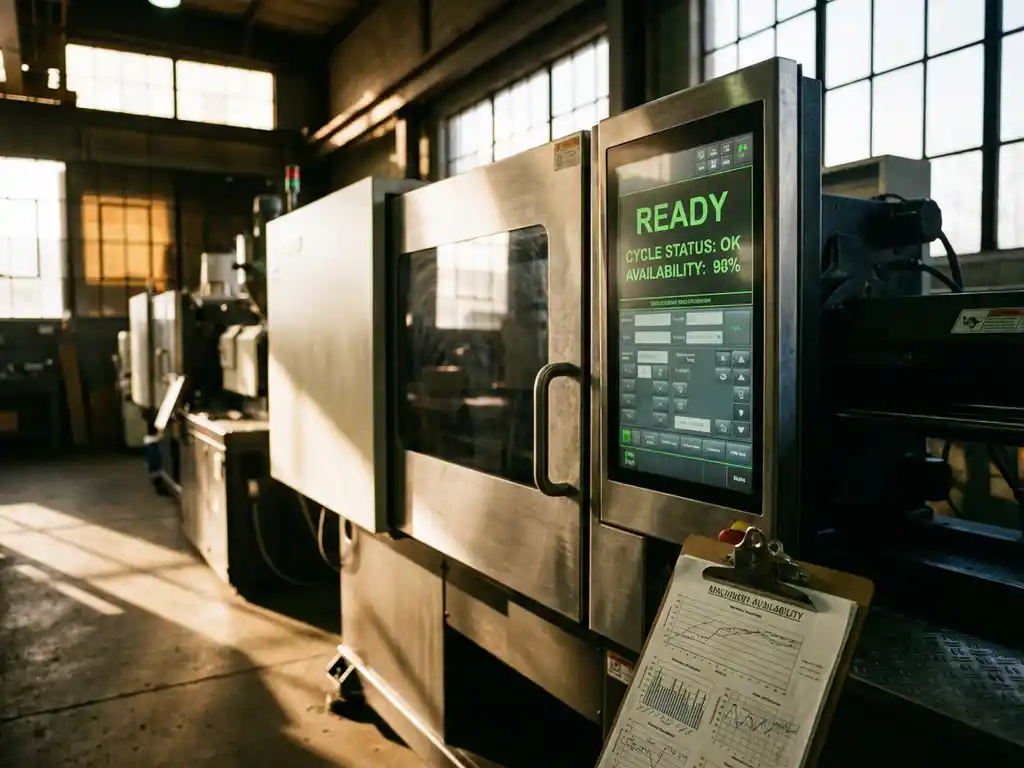
Injection molding machine availability measures the percentage of time your equipment is operational and ready for production during scheduled hours. It’s calculated using the formula: Available Time ÷ Total Scheduled Time × 100. This critical metric directly impacts production costs, delivery schedules, and overall profitability in manufacturing operations.
What is injection molding machine availability, and why does it matter?
Machine availability represents the percentage of scheduled production time during which your injection molding equipment is operational and ready to produce parts. Unlike utilization or efficiency metrics, availability focuses purely on whether the machine can run when needed.
This metric matters because every minute of downtime directly impacts your bottom line. When machines aren’t available, you’re still paying for labor, facility costs, and overhead while producing nothing. Poor availability leads to missed delivery dates, increased per-unit costs, and reduced competitiveness in the market.
Availability differs from other manufacturing metrics by measuring uptime potential rather than actual output quality or speed. A machine might be available but running slowly (a performance issue) or producing defective parts (a quality issue). Understanding this distinction helps you target improvement efforts effectively.
How do you calculate machine availability using the standard formula?
The standard availability formula is: Available Time ÷ Total Scheduled Time × 100 = Availability Percentage. Available time equals your scheduled production hours minus all downtime periods, whether planned or unplanned.
Here’s a practical example: If you schedule 16 hours of production daily but experience 2 hours of downtime, your available time is 14 hours. The calculation becomes: 14 ÷ 16 × 100 = 87.5% availability.
Total scheduled time includes only planned production hours, not breaks, shift changes, or weekends unless you operate continuously. Common calculation mistakes include counting break time as downtime or including quality issues that don’t stop the machine.
Track downtime in categories: planned maintenance, mold changes, breakdowns, material shortages, and setup adjustments. This categorization helps identify which factors most impact your availability calculations.
What factors typically reduce injection molding machine availability?
Planned downtime includes scheduled maintenance, mold changeovers, machine setup, and preventive servicing. Unplanned downtime involves equipment breakdowns, quality issues requiring stoppages, material shortages, and unexpected repairs that halt production.
Mold changes often represent the largest planned downtime category in injection molding optimization. Traditional changeover methods can require 2–8 hours, depending on mold complexity and crane availability. This extended downtime significantly reduces daily availability percentages.
Equipment breakdowns create the most costly availability losses because they’re unpredictable and often require emergency repairs. Common breakdown causes include hydraulic failures, heating-element problems, and worn mechanical components.
Operational inefficiencies also impact availability through extended setup times, waiting for materials or quality approvals, and coordination delays between shifts. These factors accumulate throughout production schedules, reducing overall machine availability.
How can quick mold change systems improve machine availability?
Quick mold change systems reduce changeover times from hours to minutes by eliminating manual handling, standardizing connections, and automating clamping processes. This dramatic time reduction directly increases the available-time component in your availability calculation.
Traditional mold changes require crane operations, manual bolt removal, utility disconnections, and lengthy setup procedures. Quick mold change systems use standardized couplers, automated clamping, and integrated handling equipment to streamline the entire process.
The availability impact is substantial: reducing a 4-hour changeover to 30 minutes adds 3.5 hours of available production time. Over multiple changeovers per week, this improvement can increase overall machine availability by 10–20 percentage points.
Automated systems also reduce changeover variability, making downtime more predictable for production planning. This consistency helps maintain higher availability levels across different operators and shift patterns.
What’s the difference between availability, performance, and quality in OEE?
Overall Equipment Effectiveness (OEE) combines three metrics: Availability measures uptime, Performance measures speed efficiency, and Quality measures good parts produced. Each component addresses different aspects of manufacturing effectiveness.
Availability answers „Was the machine running when scheduled?“ Performance asks „How fast did it run compared to ideal speed?“ Quality determines „How many good parts were produced versus total parts made?“
Tracking all three metrics provides complete production visibility because problems often span multiple categories. A machine might show good availability but poor performance due to speed reductions, or excellent availability and performance but low quality due to defect rates.
The OEE calculation multiplies all three percentages: Availability × Performance × Quality = OEE. This multiplication means weakness in any single area significantly impacts overall effectiveness, highlighting the importance of balanced improvement efforts.
How do you benchmark and improve injection molding machine availability?
World-class injection molding facilities typically achieve 85–95% availability, while average operations range from 65–80%. Your benchmark depends on product complexity, changeover frequency, and equipment age, but consistent measurement enables meaningful improvement.
Systematic improvement starts with detailed downtime tracking to identify the largest availability losses. Focus improvement efforts on the most significant downtime categories rather than trying to address all issues simultaneously.
Implementation strategies include preventive maintenance programs to reduce unplanned downtime, standardized changeover procedures to minimize setup variations, and operator training to improve troubleshooting capabilities. Quick changeover systems offer the most dramatic availability improvements for facilities with frequent mold changes.
Track progress through daily availability reports, weekly trend analysis, and monthly improvement reviews. Set realistic improvement targets based on your current performance and available resources, typically aiming for 2–5 percentage point improvements per quarter through focused efforts.
How EAS Change Systems Maximizes Your Machine Availability
EAS Change Systems provides proven solutions to dramatically increase injection molding machine availability by eliminating the biggest source of planned downtime: mold changeovers. Our automated quick mold change systems transform traditional 2-8 hour changeover processes into 15-30 minute operations, directly adding hours of available production time to your daily schedule. Key benefits include:
- Reduce changeover times by up to 90% with automated clamping and standardized connections
- Increase overall machine availability by 10-20 percentage points through faster, more predictable changeovers
- Eliminate crane dependency and manual handling that create scheduling bottlenecks
- Standardize changeover procedures across all operators and shifts for consistent results
- Reduce changeover-related safety risks and operator fatigue
Ready to maximize your injection molding machine availability and boost production capacity? Contact EAS Change Systems today for a customized assessment of how our quick changeover solutions can transform your manufacturing operations and deliver measurable ROI through increased uptime.