

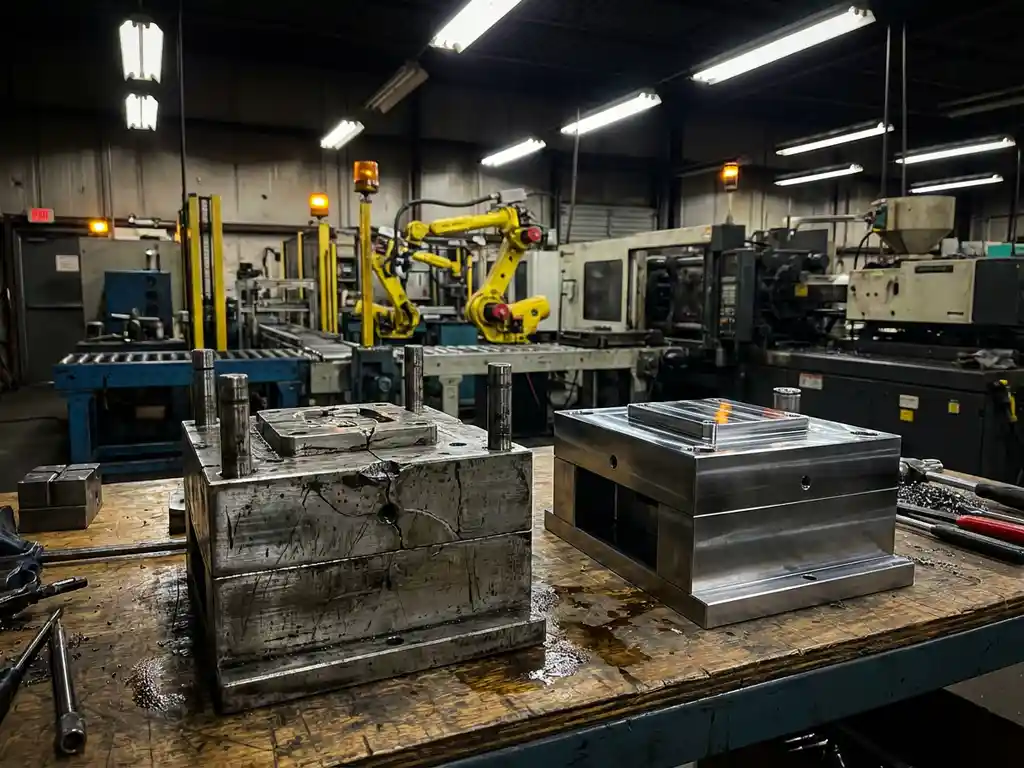
Manufacturing efficiency in injection molding hinges on many factors, but few are as critical as proper mold design. When molds are poorly designed, the ripple effects extend far beyond simple quality issues, creating cascading problems that can bring entire production lines to a halt. Reducing production downtime becomes a top priority when manufacturers realize how design flaws in their tooling directly translate into lost revenue and missed deadlines.
Poor mold design doesn’t just cause occasional hiccups in production; it creates systematic vulnerabilities that lead to predictable, recurring downtime events. Understanding these design-related failures is essential for any manufacturer serious about troubleshooting injection molding issues and maintaining competitive production schedules.
What Are the Main Ways Poor Mold Design Causes Downtime?
Poor mold design causes downtime through four primary mechanisms: inadequate cooling systems that create cycle-time delays, improper venting that leads to trapped air and defective parts, insufficient gate design that causes flow imbalances, and weak structural elements that fail under production stress.
Cooling system deficiencies represent the most common design-related cause of downtime. When cooling channels are poorly positioned or inadequately sized, parts take longer to solidify, extending cycle times and reducing throughput. More critically, uneven cooling creates warpage and dimensional instability, forcing operators to stop production for quality adjustments or to reject parts.
Venting problems create another significant source of interruption. Inadequate vents trap air during injection, causing burn marks, short shots, or incomplete fills. These defects require immediate production stops for mold cleaning, parameter adjustments, or part sorting. Gate design issues compound these problems by creating uneven flow patterns that lead to weld lines, sink marks, or flow hesitation.
Structural design weaknesses manifest as cracked mold bases, worn guide pins, or damaged ejector systems. These failures often occur suddenly during production runs, requiring emergency maintenance and extended downtime for repairs or replacement.
How Much Downtime Can Poor Mold Design Actually Cost?
Poor mold design can cost manufacturers between 15% and 30% of their total production capacity through various downtime events, with individual incidents ranging from 30 minutes for minor adjustments to several days for major mold repairs or replacements.
The financial impact varies significantly based on production volume and part complexity. For high-volume operations running 24/7, even a two-hour downtime event can cost thousands of dollars in lost production. When design flaws require mold modifications or rebuilds, costs escalate rapidly due to both repair expenses and extended production interruptions.
Recurring design-related issues create the most substantial long-term costs. A mold with chronic cooling problems might add 10 to 15 seconds to each cycle—seemingly minor, but devastating when multiplied across millions of cycles. Similarly, venting issues that require frequent cleaning or parameter adjustments can reduce overall equipment effectiveness by 20% or more.
Beyond direct production losses, poor mold design creates hidden costs through increased scrap rates, additional quality inspections, expedited shipping to meet delayed deliveries, and overtime labor to compensate for lost production time.
What’s the Difference Between Design-Related and Operational Downtime?
Design-related downtime stems from inherent flaws in the mold’s engineering and construction, while operational downtime results from process variations, material issues, or equipment wear during normal production.
Design-related downtime is typically predictable and recurring. These issues manifest consistently across production runs because they’re built into the mold’s fundamental structure. Examples include systematic cooling problems, chronic ejection difficulties, or repetitive venting issues that appear regardless of operator skill or process optimization.
Operational downtime, in contrast, varies with external factors such as material-quality fluctuations, machine maintenance schedules, or operator experience. These interruptions can often be minimized through better process control, preventive maintenance, or operator training.
The key distinction lies in the solution approach. Operational downtime responds to process improvements and maintenance protocols, while design-related downtime requires mold modifications, replacement, or fundamental redesign. Understanding this difference is crucial for effective injection molding troubleshooting because it determines whether solutions focus on process optimization or tooling changes.
How Do Cooling System Defects in Molds Affect Production?
Cooling system defects in molds affect production by extending cycle times, creating dimensional variations, and causing thermal stress that leads to part defects and increased scrap rates.
Inadequate cooling capacity forces longer cycle times as operators wait for parts to solidify sufficiently for ejection. Even a 10-second increase in cycle time can reduce daily production by hundreds of parts in high-volume operations. More problematically, insufficient cooling often creates uneven temperature distribution across the mold, leading to warpage, sink marks, and dimensional instability.
Poorly designed cooling channels create hot spots that cause localized overheating, leading to material degradation, discoloration, or burning. These thermal issues require immediate production stops for parameter adjustments, mold cleaning, or quality sorting. In severe cases, overheating can damage the mold itself, requiring extensive repairs.
Cooling system blockages or leaks represent critical failure modes that can shut down production entirely. Blocked cooling lines create thermal runaway conditions, while coolant leaks contaminate the production environment and pose safety risks. Both scenarios require immediate production cessation and emergency maintenance intervention.
What Role Does Mold Maintenance Play in Design-Related Downtime?
Mold maintenance plays a reactive role in design-related downtime, serving as a temporary mitigation strategy rather than a permanent solution. Maintenance cannot fix fundamental design flaws; it can only manage their symptoms and extend mold life.
Well-designed molds require minimal maintenance and exhibit predictable wear patterns that can be managed through scheduled service intervals. Poorly designed molds, however, create accelerated wear, unpredictable failure modes, and increased maintenance frequency that disrupt production schedules.
Design flaws often manifest as maintenance challenges that seem operational but are actually structural. For example, chronic ejector-pin binding might appear to be a lubrication issue but could result from inadequate draft angles or improper pin placement. Similarly, recurring gate freeze-off problems might seem process-related but actually stem from poor gate design or inadequate heating.
The maintenance burden of poorly designed molds extends beyond direct repair costs to include increased spare-parts inventory, specialized tooling requirements, and skilled technician time. These molds often require custom solutions and workarounds that increase complexity and reduce overall production reliability.
How Can Quick Mold Change Systems Reduce Design-Related Downtime?
Quick mold change systems reduce design-related downtime by enabling rapid switching to backup molds when primary molds experience design-related failures, minimizing production interruptions while problematic molds undergo repair or modification.
Traditional mold changes require hours of manual setup, making it impractical to switch molds when design problems occur. Quick-change systems reduce this time to minutes, making it economically viable to maintain backup molds for critical production runs. When a primary mold experiences design-related issues, operators can quickly switch to an alternative while the problematic mold is serviced offline.
These systems also facilitate faster implementation of design improvements. When mold modifications are completed, quick-change technology allows immediate testing and validation without extended production interruptions. This capability encourages proactive mold improvements rather than reactive repairs, ultimately reducing long-term downtime.
Quick mold change systems enable more flexible production scheduling that can work around known design limitations. Manufacturers can sequence production to minimize the impact of molds with chronic issues while maintaining overall throughput targets.
How EAS Change Systems Helps with Production Downtime Reduction
We provide comprehensive quick mold change solutions that directly address design-related downtime challenges through our advanced QMC systems and supporting technologies. Our approach combines rapid mold-switching capabilities with integrated support systems that minimize production interruptions.
- Quick mold change systems that reduce changeover times from hours to minutes, enabling rapid switching when design issues occur
- Adaptive clamping systems that accommodate various mold designs and reduce setup complexity
- Mold transportation and handling equipment that safely manages backup molds and facilitates rapid deployment
- Comprehensive system integration, including ejector couplers, cooling connections, and electrical interfaces, for seamless mold changes
- Expert application engineering to optimize your specific production requirements and mold management strategies
Our global experience since 1985 in reducing factory automation costs positions us to help you develop effective strategies for managing design-related downtime. Contact us today to discuss how our quick mold change solutions can improve your production reliability and reduce the impact of mold design challenges on your operations.