

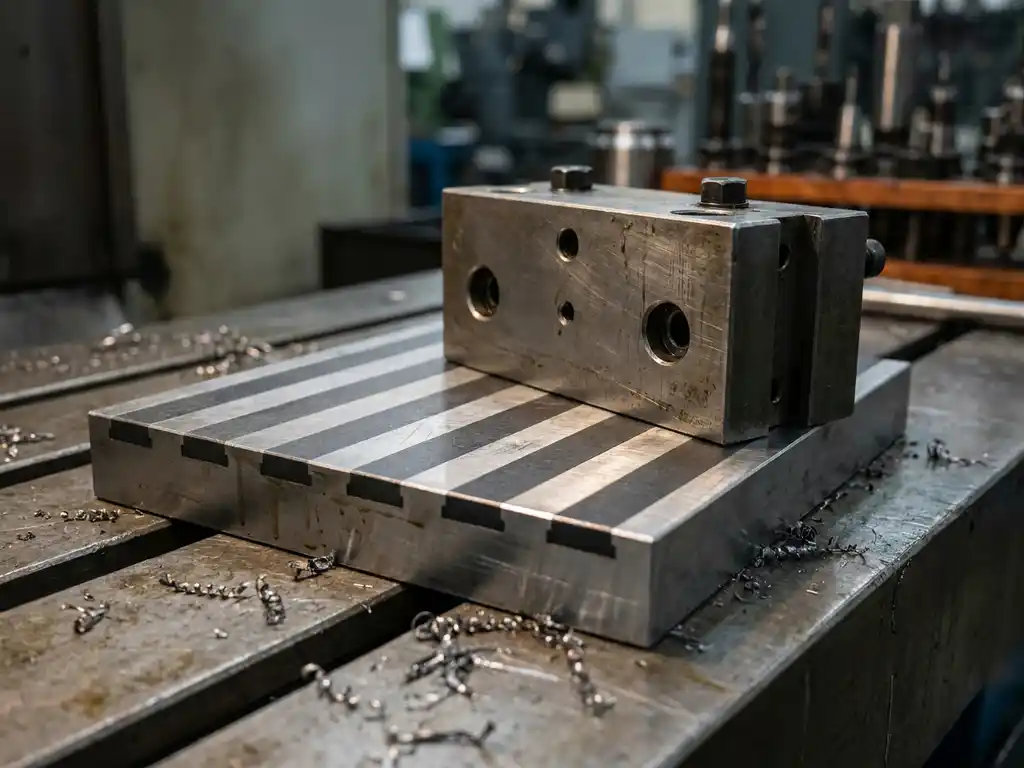
To select the right pole pitch for a magnetic clamping system, match the pitch to your mold base thickness and material: a smaller pole pitch suits thinner mold bases, while a larger pole pitch is needed for thicker bases to allow the magnetic field to penetrate deeply enough for secure clamping. The size of your injection molding machine and the weight and geometry of the mold also play a defining role in this decision. The sections below walk through each key factor in detail.
What factors determine the ideal pole pitch for your application?
The ideal pole pitch for a magnetic clamping system is determined by four primary factors: mold base thickness, mold base material, machine platen size, and mold weight. Pole pitch is the distance between alternating magnetic poles on the clamping plate, and it directly controls how deep the magnetic flux penetrates into the mold base. Getting this match right is the foundation of safe, stable clamping.
Each of these factors interacts with the others. A large, heavy mold made from standard tool steel on a wide-platen machine calls for a different configuration than a compact mold on a small press. Consider all four together rather than optimizing for just one. To explore the full range of magnetic clamping products available for different machine and mold configurations, reviewing the product lineup is a useful starting point:
- Mold base thickness: The most critical factor. The magnetic field must fully saturate the base to generate maximum holding force.
- Mold base material: Magnetic permeability varies between steel grades, affecting how efficiently flux travels through the base.
- Machine platen size: Larger platens require clamping plates with broader coverage, which typically means a larger pole pitch.
- Mold weight and geometry: Heavier or asymmetric molds demand higher clamping force, which influences which pitch range is appropriate.
How does pole pitch affect clamping force and mold stability?
Pole pitch directly determines how deep the magnetic flux penetrates the mold base, which in turn controls the achievable clamping force. A smaller pole pitch concentrates flux near the surface, generating strong force in thin bases but losing effectiveness in thicker ones. A larger pole pitch drives flux deeper, making it essential for thick mold bases where surface-level flux would leave the mold under-clamped.
Mold stability is the practical consequence of getting this right. If the pole pitch is too small for the base thickness, the magnetic circuit is incomplete. The mold may appear clamped but will not have the full rated holding force, creating risk during injection, particularly under high injection pressures or with side-action molds that generate lateral forces. Conversely, an oversized pole pitch on a thin base wastes capacity without adding meaningful stability. The goal is a pitch that fully saturates the base material across its entire thickness, so the clamping force is uniform and predictable across the platen face.
What is the minimum mold base thickness for a given pole pitch?
Each pole pitch value has a corresponding minimum mold base thickness below which the magnetic circuit cannot close properly. As a general principle, the minimum base thickness should be at least equal to half the pole pitch. For example, a clamping plate with a 50 mm pole pitch typically requires a mold base of at least 25 mm on the clamped face to achieve full rated force.
Using a mold base that is thinner than the minimum for a given pitch means the flux cannot complete its path through the steel. The result is a significant reduction in clamping force, sometimes well below the level needed for safe operation. Always verify the minimum thickness specification provided by the magnetic clamping system manufacturer for each product model, since the exact threshold varies by design. If your mold base is close to the minimum, consider whether a smaller pole pitch variant is available, or whether adding a ferromagnetic backing plate is a practical option for your setup.
Does mold base material affect which pole pitch to choose?
Yes, mold base material significantly affects pole pitch selection because different steel grades have different magnetic permeability values. High-permeability tool steels, such as standard P20 or 1.2311, conduct magnetic flux efficiently, meaning the field penetrates deeply and the clamping force is close to the rated maximum. Lower-permeability or austenitic stainless steels conduct flux poorly and may require a different pitch or may not be compatible with magnetic clamping at all.
In practice, most injection mold bases are made from carbon or low-alloy tool steels that are well-suited to magnetic clamping. However, if your molds use hardened inserts, stainless components, or non-standard alloys in the base plates, test or confirm compatibility before specifying a pole pitch. Material certification sheets from your mold maker can help identify the steel grade, and your magnetic clamping supplier can advise on expected flux penetration and force output for that specific material.
How do you match pole pitch to your injection molding machine size?
Match pole pitch to machine size by first establishing the platen dimensions and the range of mold sizes you run on that machine. Larger platens typically accommodate larger clamping plates, which are designed around larger pole pitches to maintain force uniformity across a wider surface. Smaller machines with compact platens use clamping plates with finer pitch grids suited to smaller, lighter molds.
The practical steps for this matching process are straightforward:
- Define your mold size range: Identify the smallest and largest molds that will run on the machine. The clamping system must handle both extremes safely.
- Check platen dimensions and tie-bar spacing: These set the physical limits on clamping plate size and layout.
- Calculate required clamping force: Based on the heaviest mold and highest injection pressure in your application, determine the minimum holding force needed.
- Select a pole pitch that achieves that force for your thickest base: Confirm the pitch penetrates deeply enough for your maximum base thickness.
- Verify fit for your thinnest base: Ensure the chosen pitch does not exceed the maximum recommended base thickness ratio for your lightest mold.
If your machine runs a very wide variety of mold sizes and thicknesses, a system with interchangeable or modular clamping plates in different pitch configurations may be the most flexible solution. Reviewing the range of supported applications can help clarify which configuration best fits your production environment.
When should you consult a specialist instead of selecting pole pitch yourself?
Consult a specialist when your application falls outside standard parameters: mixed mold materials, unusually thin or thick base plates, high-speed cycling, multi-cavity molds with complex geometry, or machines with non-standard platen configurations. In these cases, the interaction between pole pitch, flux penetration, and clamping force becomes difficult to calculate reliably without detailed engineering analysis.
Other situations that warrant specialist input include:
- Molds with side cores or lifters that generate significant lateral ejection forces during the molding cycle
- Applications where the mold base material is not a standard tool steel grade
- Retrofit projects where the existing platen layout limits clamping plate placement options
- High-tonnage machines where the consequences of under-clamping are severe
- Situations where you need a documented ROI calculation before committing to a system
In these scenarios, an application engineer can model the magnetic circuit, verify force margins, and recommend the correct configuration. The cost of a consultation is negligible compared to the cost of a mold drop or an unplanned production stoppage caused by an incorrect pole pitch selection.
How EAS Change Systems helps you choose the right magnetic clamping configuration
Selecting the right pole pitch is not something you need to figure out alone. At EAS Change Systems, we support manufacturers through the full selection and implementation process, from initial application review to system installation and validation. Our magnetic clamping solutions include the Pressmag LP and SP series, designed to cover a wide range of mold sizes, base thicknesses, and machine configurations. Here is what we bring to the process:
- Application engineering: We analyze your mold portfolio, machine specifications, and production requirements to recommend the correct pole pitch and clamping plate configuration.
- Magnetic clamping product range: Our Pressmag LP and SP systems offer different pole pitch options to match thin and thick mold bases across small and large machine platens.
- ROI calculation: We provide a concrete return-on-investment analysis so you can justify the investment internally before committing.
- Installation and commissioning: Our teams handle system integration into new and existing equipment, including OEM installations.
- Ongoing service and maintenance: We support your system after installation to keep clamping performance at rated levels over the long term.
If you are ready to find the right magnetic clamping setup for your machines, get in touch with our team today. We will review your application and give you a clear, specific recommendation.