

Tracking the right performance benchmarks separates manufacturers who guess from those who improve with confidence. For engineers working with magnetic clamping systems, having a clear set of measurable indicators makes it possible to evaluate system health, justify capital investment, and build a case for continuous improvement. Whether you are optimizing an existing setup or evaluating a new installation, these seven benchmarks give you the data foundation you need.
How magnetic clamping performance shapes production efficiency
Magnetic clamping technology has transformed how injection molding operations manage mold changes. Unlike mechanical or hydraulic alternatives, magnetic clamping eliminates the need for manual bolt tightening, reduces operator variability, and creates a repeatable, controlled clamping force across the entire platen surface. The result is faster changeovers, more consistent part quality, and a lower risk of mold damage.
But even the best clamping systems only deliver their full potential when engineers actively monitor key performance indicators. The seven benchmarks below cover the full performance picture, from cycle speed to financial return, giving your team a structured framework for ongoing evaluation.
1: Mold change cycle time reduction
Cycle time reduction is the most visible benefit of switching to magnetic clamping, and it is the first benchmark every engineer should establish. The core question is simple: how long does a complete mold change take from the moment production stops to the moment it restarts?
With traditional mechanical clamping, changeovers involving multiple bolts, manual torque checks, and repeated alignment steps can take anywhere from one to several hours depending on mold size and complexity. Magnetic systems compress that window dramatically. A well-configured magnetic clamping system can bring changeover times down to single-digit minutes, which directly increases machine availability and production output.
To benchmark this accurately, time each changeover from mold removal to the first good part, and track the average across a rolling window of at least 20 cycles. This eliminates outliers caused by operator learning curves or occasional equipment issues and gives you a reliable baseline for improvement.
2: Clamping force consistency across the platen
Uniform clamping force across the entire mold mounting surface is critical for part quality and mold longevity. Inconsistent force distribution creates uneven stress on the mold, which can lead to flash, dimensional variation, and premature wear on mold components.
Magnetic clamping systems generate force through the entire contact area rather than at discrete bolt points, which inherently supports better distribution. However, the actual consistency depends on platen flatness, mold back plate condition, and the magnetic circuit design of the system itself. Exploring the full range of available clamping products can help engineers identify which system configuration best suits their platen and mold specifications.
Engineers should benchmark clamping force using a pressure-sensitive film or load cell array placed between the platen and mold back plate during a controlled test cycle. The goal is to identify any zones of significantly lower or higher force and correlate those findings with part quality data. This benchmark is especially important when running thin-walled parts or precision components where dimensional tolerance is tight.
3: What does demagnetization rate reveal about system health?
Demagnetization rate measures how much magnetic force a clamping system loses over time or after repeated activation cycles. It is one of the most informative indicators of long-term system health and is often overlooked until a problem becomes visible.
A well-maintained magnetic clamping system should retain its rated clamping force consistently across thousands of cycles. A measurable drop in holding force between calibration intervals suggests that the permanent magnets or electromagnetic components are degrading, that the system is being exposed to excessive heat, or that demagnetizing external fields are present in the environment.
Benchmark demagnetization rate by recording measured holding force at regular intervals, such as every three months or every defined number of activation cycles. Compare these readings against the manufacturer’s rated force specification. A downward trend that exceeds acceptable tolerance thresholds is an early warning signal that maintenance or component replacement is needed before a safety or quality event occurs.
4: Mold changeover repeatability and positional accuracy
Repeatability measures whether the mold lands in exactly the same position every time it is clamped. This benchmark directly affects how quickly production can resume after a changeover, since poor positional accuracy means additional time spent on alignment and first-article inspection.
Magnetic clamping systems combined with locating elements such as guide pins or reference stops can achieve very high positional repeatability, often within fractions of a millimeter. This level of precision is what makes true single-minute exchange of die (SMED) approaches achievable in practice rather than just in theory.
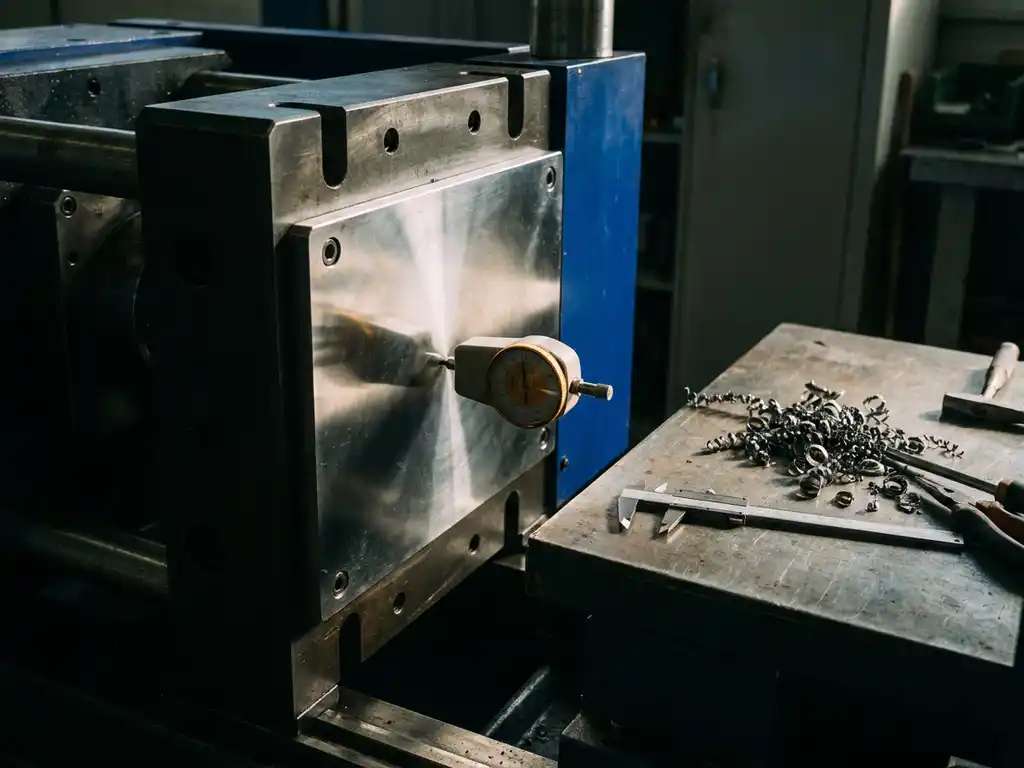
To benchmark repeatability, use a dial indicator or coordinate measurement tool to record the mold position at a fixed reference point across a series of changeovers. Calculate the variation range and standard deviation. Operations running family molds or frequent product changeovers will find this benchmark particularly valuable, as small positional errors compound across high changeover volumes.
5: Energy consumption per clamping cycle
Energy efficiency is an increasingly important factor in manufacturing operations, both for cost control and sustainability reporting. Magnetic clamping systems offer a meaningful advantage here: permanent magnet systems consume energy only during the activation and deactivation phase, not while holding the mold in place.
This is a fundamental difference from hydraulic clamping, which requires continuous pressure and therefore continuous energy input throughout the entire production run. For high-volume operations running extended production cycles, the cumulative energy savings can be substantial. Understanding how these systems perform across different manufacturing applications can help teams set realistic energy reduction targets from the outset.
Benchmark energy consumption by measuring the electrical draw during a complete activation and deactivation sequence and multiplying by the number of changeovers per month. Compare this figure against the energy profile of your previous clamping method to quantify actual savings. This data also supports sustainability reporting and internal cost reduction targets.
6: Safety system response time and fault detection speed
Safety performance is non-negotiable, and it deserves its own dedicated benchmark. In magnetic clamping applications, the safety system must detect insufficient clamping force, partial demagnetization, or a mold that has not seated correctly before the machine cycle begins.
Modern magnetic clamping systems include integrated safety monitoring that checks holding force and signals a fault condition if the measured force falls below a defined threshold. The benchmark to track is how quickly the system detects and communicates a fault, and whether that detection happens reliably before any machine motion occurs.
Test this benchmark during planned maintenance windows by intentionally introducing a partial clamping condition and verifying that the safety interlock responds within the specified time window. Document the response time and compare it against the system specification. Any degradation in detection speed should trigger immediate investigation, as this is a critical safety function rather than a performance preference.
7: Return on investment payback period
The ROI payback period translates all of the operational benchmarks above into financial terms, making it the benchmark most relevant to capital investment decisions. It answers the question that plant managers and finance teams always ask: how long before this system pays for itself?
The calculation draws on measurable inputs including time saved per changeover multiplied by machine hourly rate, reduction in scrap and rework costs, lower energy consumption, and reduced maintenance labor. When these savings are stacked against the total system cost including installation, the payback period for magnetic clamping systems is often achievable within one to two years for operations with frequent changeovers.
Benchmark this figure at the time of installation using conservative estimates, then revisit it at six and twelve months using actual operational data. The comparison between projected and actual payback is itself a valuable indicator of how well the system has been implemented and how effectively the team has adopted the new process.
Turn benchmark data into a continuous improvement plan
Collecting benchmark data is only valuable when it drives action. The most effective approach is to assign ownership of each benchmark to a specific engineer or team lead, set a review cadence, and define threshold values that trigger a structured response when performance drifts outside acceptable limits.
A simple dashboard that tracks all seven benchmarks in one view makes it easy to spot correlations. For example, a rising demagnetization rate combined with declining positional accuracy often points to the same root cause. Addressing the underlying issue resolves both metrics simultaneously and prevents a cascade of quality or safety problems downstream.
Continuous improvement in magnetic clamping performance is not a one-time project. It is an ongoing discipline that rewards the teams who measure consistently, investigate honestly, and act on what the data shows.
How EAS Change Systems helps with magnetic clamping performance
We at EAS Change Systems have been supporting manufacturers in improving their clamping performance since 1985, and we understand that the right solution depends on the specific demands of your application. Our team and history reflect a long-standing commitment to delivering measurable performance across every benchmark covered in this article.
- Pressmag LP and SP magnetic clamping systems use permanent magnet technology to secure molds without continuous energy input, supporting both energy efficiency and safety benchmarks.
- Hydraulic clamping options including MOD, ELY, and HECS clamps are available for applications where hydraulic force is preferred, giving you flexibility across different machine types and mold sizes.
- Adaptive clamping systems are engineered for integration into both existing equipment and new OEM installations, reducing implementation complexity and setup time.
- ROI calculation support is built into our project approach, so you have a clear financial baseline from day one rather than working it out retrospectively.
- Application engineering and system installation services ensure that your clamping system is configured correctly from the start, which directly impacts repeatability, force consistency, and safety performance.
If you are ready to benchmark your current clamping setup or explore what a magnetic clamping upgrade could deliver for your operation, get in touch with our team. We will work with you to identify the right solution and build a performance improvement plan grounded in real data.