

Manufacturing efficiency hinges on minimizing downtime, and one of the biggest culprits is lengthy changeover processes. When production lines sit idle during manual tool changes, manufacturers face mounting costs and missed opportunities. The question isn’t whether automation can help, but how dramatically it can transform your operation’s productivity.
Modern automated changeover systems are revolutionizing how manufacturers reduce production downtime, particularly in injection molding and stamping operations. By replacing time-consuming manual processes with precision-engineered automation, companies are discovering they can slash setup times from hours to minutes while improving safety and consistency.
What is manual changeover time, and why does it matter?
Manual changeover time refers to the period required to switch production equipment from one product or configuration to another using traditional manual methods. This includes removing old tooling, installing new components, making adjustments, and testing the setup before resuming production.
The impact extends far beyond the obvious costs of downtime. During manual changeovers, skilled operators are tied up in repetitive tasks that can take anywhere from 30 minutes to several hours, depending on complexity. This creates a cascade of inefficiencies: increased labor costs, a higher risk of injuries from heavy lifting, the potential for human error that leads to quality issues, and the opportunity cost of lost production capacity.
In injection molding operations, manual changeovers often require multiple technicians to handle heavy molds, disconnect various connections, and carefully align new tooling. Each step introduces variables that can affect final setup quality and extend the overall changeover duration.
How does automation reduce changeover time?
Automation reduces changeover time by eliminating manual handling, standardizing connection processes, and enabling simultaneous operations that would otherwise require sequential steps. Automated systems can complete changeovers in 2–5 minutes, compared to 30–120 minutes for manual processes.
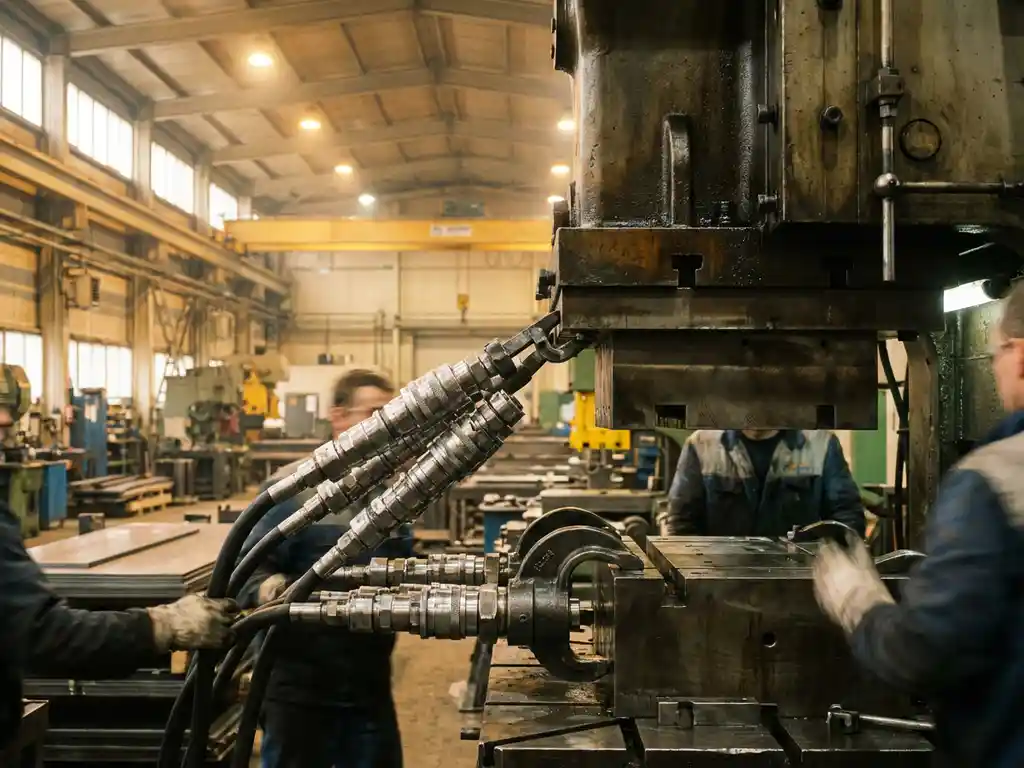
The time savings come from several key mechanisms. Automated clamping systems secure tooling with consistent force and positioning, eliminating guesswork and reducing adjustment time. Quick-connect couplers for utilities such as cooling water, hydraulics, and electrical connections snap into place instantly, rather than requiring manual threading and tightening.
Perhaps most importantly, automation enables parallel processing. While an automated system handles the physical changeover, operators can prepare the next tooling set or focus on quality-control tasks. This overlap dramatically improves overall equipment effectiveness and allows for more frequent product changes without proportional increases in downtime.
What’s the difference between manual and automated changeover systems?
Manual changeover systems rely on human operators to physically disconnect, move, and reconnect tooling using basic mechanical tools, while automated systems use pneumatic, hydraulic, or electric actuators to perform these tasks with push-button simplicity.
The operational differences are substantial. Manual systems require multiple operators, create safety risks from heavy lifting, and introduce variability in setup quality depending on operator skill and fatigue. Setup times vary significantly based on tooling complexity and operator experience.
Automated systems standardize the entire process. Clamping forces remain consistent, connections align perfectly every time, and the same changeover sequence runs regardless of shift or operator. This consistency translates to improved part quality, reduced scrap rates, and predictable production scheduling. Additionally, automated systems often include built-in safety features and can integrate with facility management systems for real-time monitoring and reporting.
How much can automation reduce setup costs?
Automation typically reduces setup costs by 60–80% through faster changeovers, reduced labor requirements, and improved production efficiency. The exact savings depend on current changeover frequency, labor rates, and production volume.
The cost reduction comes from multiple sources. Direct labor savings occur when changeovers that previously required two to three operators for several hours can be completed by one operator in minutes. Indirect savings include reduced downtime costs, lower scrap rates from consistent setups, and the ability to run smaller batch sizes economically.
In injection molding troubleshooting scenarios, automated systems also reduce diagnostic time when issues arise. Consistent clamping and connection quality eliminate many variables that can cause production problems, making it easier to identify and resolve true process issues rather than setup-related complications.
What industries benefit most from changeover automation?
Industries with frequent product changes, heavy tooling, and high-value production time benefit most from changeover automation. This includes automotive manufacturing, consumer electronics, medical device production, and packaging industries, where setup efficiency directly impacts profitability.
Injection molding operations see particularly dramatic benefits due to the complexity and weight of molds, multiple utility connections, and the precision required for consistent part quality. Metal stamping and die casting operations also realize significant advantages, especially when producing multiple part variants or managing seasonal demand fluctuations across various applications.
Companies running just-in-time manufacturing, or those facing increasing demand for customization, find changeover automation essential for maintaining competitiveness. The ability to switch between products quickly enables more flexible production scheduling and a faster response to market demands.
How do you implement changeover automation in existing facilities?
Implementation begins with analyzing current changeover processes to identify the most time-consuming steps and safety concerns. Most facilities can retrofit automation components gradually, starting with high-impact areas such as clamping systems and utility connections.
The typical implementation process involves several phases. First, conduct a changeover time study to establish baseline metrics and identify improvement opportunities. Next, prioritize automation components based on potential time savings and return on investment. Many facilities start with automated clamping systems, since these provide immediate benefits and can integrate with existing equipment.
Training plays a crucial role in successful implementation. Operators need to understand new procedures, safety protocols, and basic troubleshooting for automated systems. Planning should also include maintenance procedures and a spare-parts inventory to ensure consistent system availability.
How EAS Change Systems helps with changeover automation
We specialize in transforming manual changeover processes into efficient automated systems that deliver measurable results. Our comprehensive approach addresses every aspect of the changeover process, from initial assessment through ongoing support.
Our products include:
- Adaptive clamping systems that secure tooling with consistent force and positioning
- Quick-connect coupler systems for utilities, eliminating manual connection time
- Mold change tables and transportation vehicles for safe, efficient tooling movement
- Complete turnkey systems designed specifically for your production requirements
- ROI calculations and project management to ensure successful implementation
- Ongoing service and maintenance support to maximize system uptime
With over 35 years of experience and installations across three continents, we bring proven expertise to your changeover automation project. Contact us today to discover how much time and money you could save with automated changeover systems tailored to your specific production needs.