

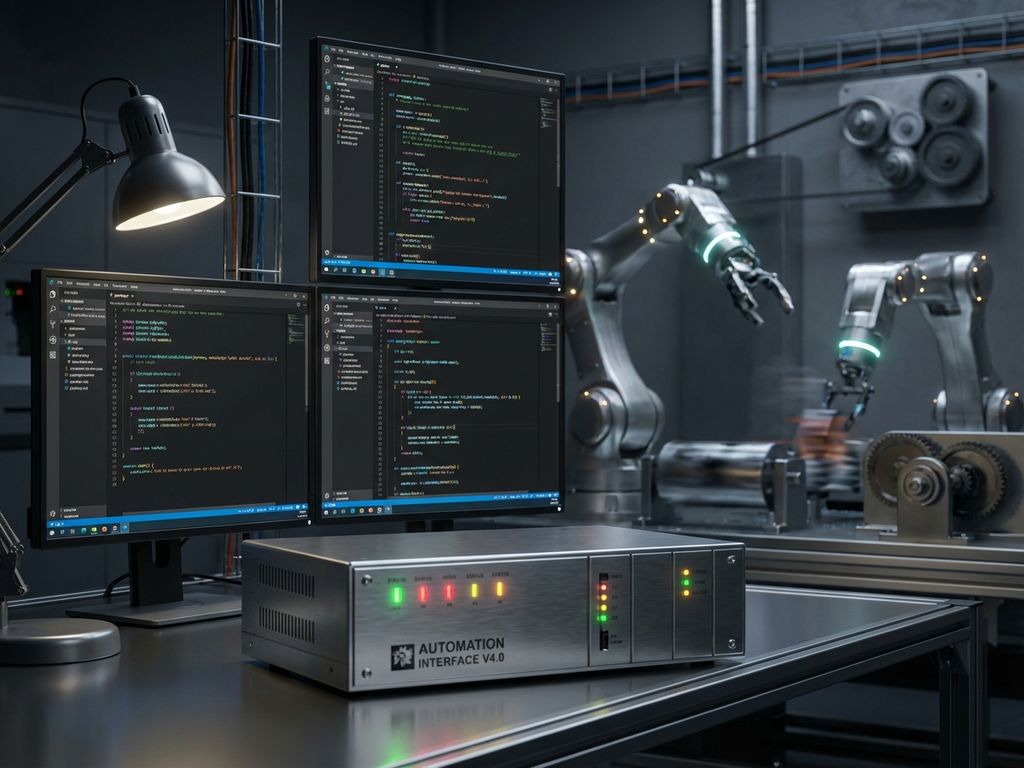
Industrial automation relies on several specialised programming languages designed for control systems and manufacturing processes. The most common include ladder logic, structured text, function block diagrams, and high-level languages like Python and C++. Each serves specific automation needs, from real-time control to data analysis and system integration within manufacturing automation environments.
What programming languages are most commonly used in industrial automation?
Industrial automation primarily uses five core programming languages defined by the IEC 61131-3 standard: ladder diagram, structured text, function block diagram, instruction list, and sequential function chart. Additionally, high-level languages like Python, C++, and Java play crucial roles in modern automation systems.
Ladder logic remains the most widely used language in manufacturing automation because it resembles electrical relay circuits, making it intuitive for engineers with electrical backgrounds. It excels in discrete control applications like conveyor systems and safety interlocks.
Structured text offers a high-level programming approach similar to Pascal, ideal for complex mathematical calculations and data manipulation. Function block diagrams provide visual programming for process control, particularly useful in continuous manufacturing processes.
Python has gained significant traction for data analysis, machine learning integration, and system monitoring. C++ handles real-time applications requiring precise timing and memory management, while Java supports enterprise-level integration and web-based human-machine interfaces.
How do you choose the right programming language for automation projects?
Selecting the appropriate programming language depends on system requirements, hardware compatibility, team expertise, maintenance considerations, and project complexity. The choice significantly impacts development time, system performance, and long-term maintainability.
Consider your hardware platform requirements. Traditional PLCs work best with IEC 61131-3 languages like ladder logic or structured text. Industrial PCs and embedded systems offer more flexibility, supporting Python, C++, or .NET languages for advanced functionality.
Evaluate your team’s expertise and training requirements. Ladder logic requires minimal programming background but limits complex operations. Python offers rapid development and extensive libraries but may lack real-time performance. C++ provides maximum control but demands experienced programmers.
Project complexity guides language selection. Simple on/off control suits ladder logic perfectly. Complex data processing, predictive maintenance, or machine learning applications benefit from Python or C++. Mixed applications often require multiple languages working together through appropriate interfaces.
What’s the difference between PLC programming languages and traditional software languages?
PLC programming languages are specifically designed for real-time control and industrial environments, while traditional software languages focus on general computing applications. PLC languages prioritise deterministic execution, safety, and reliability over computational flexibility.
The IEC 61131-3 standard defines PLC languages with built-in safety features, standardised function blocks, and real-time execution guarantees. These languages handle input/output operations, timing functions, and safety interlocks as fundamental features rather than add-on libraries.
Traditional programming languages offer greater computational power and flexibility but require additional frameworks for industrial communication protocols, real-time constraints, and safety systems. They excel in data processing, user interfaces, and system integration tasks.
Execution models differ significantly. PLC languages use scan-based execution cycles, processing inputs, executing logic, and updating outputs in predictable timeframes. Traditional languages use event-driven or procedural execution models that may not guarantee timing requirements critical in manufacturing automation.
Why is Python becoming popular in industrial automation programming?
Python’s popularity in industrial automation stems from its extensive libraries for data analysis, machine learning capabilities, rapid prototyping speed, and excellent integration with existing systems. It bridges the gap between traditional control systems and modern data-driven manufacturing approaches.
The language excels in predictive maintenance applications, quality control systems, and production optimisation through its powerful data science libraries like pandas, NumPy, and scikit-learn. Python easily connects to databases, web services, and cloud platforms essential for Industry 4.0 implementations.
Python’s readability and shorter development cycles make it ideal for prototyping automation solutions and creating custom tools for manufacturing engineers. Its extensive communication libraries support industrial protocols like Modbus, OPC UA, and MQTT without complex configuration.
However, Python has limitations in hard real-time control applications due to its interpreted nature and garbage collection. It works best for supervisory control, data analysis, and system integration rather than direct machine control requiring microsecond-precision timing.
How do EAS change systems integrate advanced programming for quick mould change automation?
We utilise sophisticated programming languages and control systems to deliver automated quick mould change and quick die change solutions that reduce setup times from hours to minutes. Our programming approach combines real-time control with intelligent system optimisation for maximum efficiency.
Our manufacturing automation solutions integrate multiple programming technologies:
- Advanced PLC programming using structured text for complex sequence control and safety interlocks
- Human-machine interface development for intuitive operator control and system monitoring
- Motion control programming for precise positioning of mould change equipment and transportation systems
- Data collection and analysis systems for performance monitoring and predictive maintenance
- Integration protocols connecting with existing factory automation systems and ERP platforms
Our programming expertise enables adaptive clamping systems, automated ejector coupling, and intelligent mould transportation that responds to different mould configurations automatically. The result is consistent, reliable changeovers with minimal operator intervention and maximum safety.
Ready to transform your production efficiency with advanced quick change automation? Contact our engineering team to discuss how our products can optimise your manufacturing processes and reduce costly downtime.
