
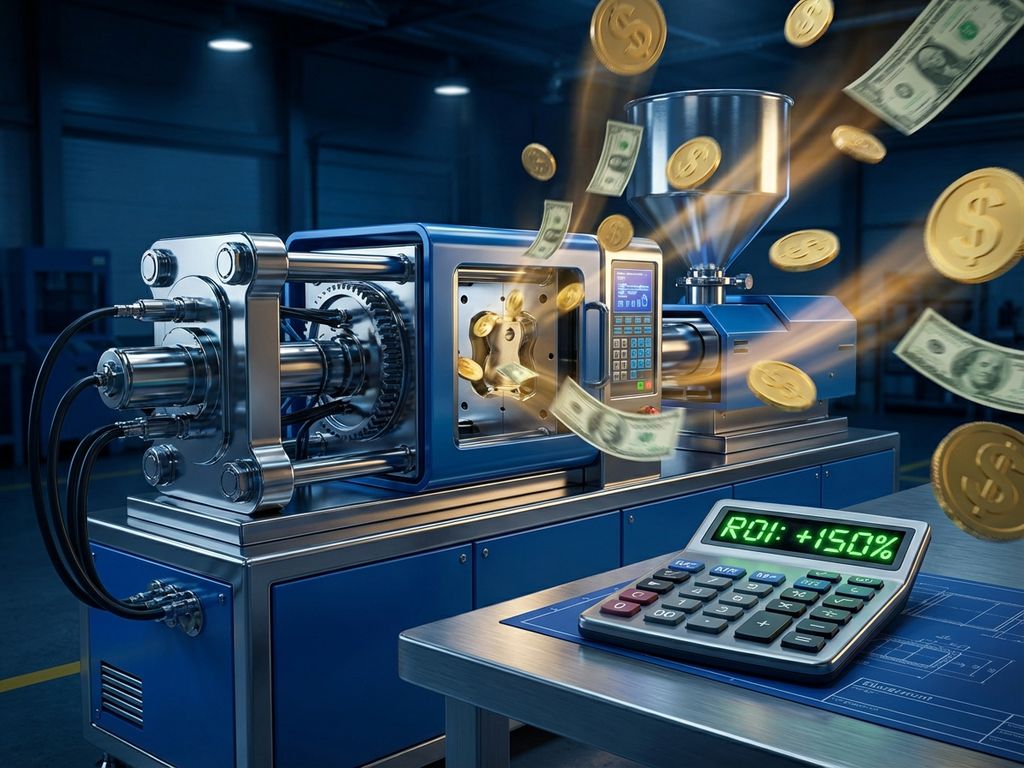
Calculating injection molding ROI involves measuring the financial returns from equipment investments against their costs over time. The calculation includes initial equipment costs, operational savings, productivity gains, and reduced waste. Proper ROI analysis helps manufacturers make informed decisions about equipment upgrades, process improvements, and automation investments that can significantly impact profitability.
What factors should you include in injection molding ROI calculations?
Injection molding ROI calculations should include initial equipment costs, installation expenses, training costs, maintenance requirements, and ongoing operational expenses. You must also factor in productivity improvements, material savings, labor cost reductions, quality improvements, and energy efficiency gains to get an accurate picture of your investment returns.
The initial investment encompasses more than just the equipment purchase price. Consider installation costs, facility modifications, electrical upgrades, and any necessary infrastructure changes. Training expenses for operators and maintenance staff represent another crucial component that many manufacturers overlook during initial planning.
Revenue-generating factors include increased production capacity, reduced cycle times, improved part quality, and decreased scrap rates. Material savings from better precision and reduced waste can substantially impact your bottom line. Energy efficiency improvements from newer equipment often provide ongoing cost reductions throughout the equipment’s lifecycle.
Don’t forget indirect benefits such as improved workplace safety, reduced insurance costs, enhanced product consistency, and increased customer satisfaction. These factors might be harder to quantify but contribute meaningfully to your overall return on investment.
How do you calculate the actual ROI for injection molding equipment?
Calculate injection molding ROI using the formula: ROI = (Net Profit from Investment – Cost of Investment) ÷ Cost of Investment × 100. Net profit includes all savings and additional revenue generated minus ongoing costs. This percentage shows how much return you receive for every pound invested in the equipment.
Start by determining your total investment cost, including equipment price, installation, training, and setup expenses. Next, calculate annual benefits such as increased production output, reduced labor costs, material savings, and maintenance cost reductions compared to your previous setup.
Track ongoing operational costs, including energy consumption, maintenance expenses, and any additional labor requirements. Subtract these from your total benefits to determine net annual savings. Divide this figure by your total investment to get your annual ROI percentage.
Consider using payback period calculations alongside ROI. This shows how long it takes to recover your initial investment through operational savings. Most injection molding equipment investments should show positive ROI within 2–4 years, depending on production volume and efficiency gains.
What’s the difference between short-term and long-term ROI in injection molding?
Short-term ROI focuses on immediate benefits like reduced setup times and increased production capacity within the first 1–2 years. Long-term ROI includes cumulative savings, equipment depreciation, maintenance cost patterns, and sustained productivity improvements over the equipment’s entire lifecycle, typically 10–15 years.
Short-term benefits are often easier to measure and include immediate productivity gains, reduced changeover times, and quick wins from improved efficiency. These typically appear within months of installation and provide early validation of your investment decision.
Long-term ROI reveals the true value of your investment through sustained operational improvements, reduced total cost of ownership, and enhanced competitive positioning. Equipment reliability, consistent quality improvements, and cumulative material savings become more significant over extended periods.
Consider how technological advances might affect long-term ROI. Equipment that is easily upgradeable or compatible with future automation systems provides better long-term value than systems that become obsolete quickly. Factor in potential resale value and the equipment’s ability to adapt to changing production requirements.
Why do setup time reductions dramatically impact injection molding ROI?
Setup time reductions create exponential ROI improvements because they increase available production time, enable smaller batch runs, reduce labor costs, and improve overall equipment effectiveness. Even modest setup time improvements can generate substantial annual savings when multiplied across hundreds of changeovers per year.
Traditional mold changes can take several hours, during which expensive equipment sits idle. Quick changeover systems can reduce these times to minutes, dramatically increasing productive capacity without additional equipment investment. This increased uptime directly translates to higher revenue potential.
Faster setups enable more flexible production scheduling, allowing manufacturers to respond quickly to customer demands and produce smaller batch sizes economically. This flexibility often leads to improved customer relationships and the ability to charge premium prices for responsive service.
Reduced setup times also decrease labor costs associated with changeovers and minimize the risk of setup errors that can result in costly scrap production. The cumulative effect of these improvements often makes setup time reduction one of the highest-impact investments in injection molding operations.
How do you measure ROI improvements from quick mold change systems?
Measure quick mold change ROI by comparing changeover times before and after implementation, calculating increased production capacity, and quantifying labor savings. Track metrics including setup time reduction, additional production hours gained, decreased scrap rates during changeovers, and improved overall equipment effectiveness scores.
Document baseline measurements before implementing quick change systems, including average changeover times, labor hours required, and typical scrap rates during setup periods. These benchmarks are essential for accurate ROI calculations and progress tracking.
Monitor production capacity increases by measuring additional parts produced due to reduced downtime. Calculate the revenue value of this increased capacity based on your typical profit margins. Include both direct sales increases and improved ability to meet customer delivery requirements.
Track secondary benefits such as reduced operator fatigue, improved workplace safety, and enhanced production scheduling flexibility. Measure quality improvements during startup after changeovers, as quick change systems often provide more consistent and repeatable setups than manual processes.
How EAS change systems help with injection molding ROI optimization
We provide comprehensive quick mold change solutions that dramatically reduce changeover times from hours to minutes, maximizing your production capacity and ROI. Our systems deliver measurable improvements in setup efficiency, production flexibility, and operational cost reduction.
Our ROI optimization solutions include:
- Advanced clamping systems that eliminate manual bolting and reduce changeover times by up to 90%
- Automated coupler systems for quick connection of utilities, cooling lines, and ejector systems
- Mold handling equipment including change tables and transportation vehicles for safe, efficient mold movement
- Comprehensive ROI calculation services to quantify your investment returns and payback periods
- Complete project management from system design through installation and operator training
We work with manufacturers worldwide to implement turnkey solutions that deliver proven ROI improvements through reduced setup times, increased production capacity, and enhanced operational efficiency. Our engineering team provides detailed ROI analysis and ongoing support to ensure you achieve maximum returns from your investment.
Explore our complete range of quick mold change products to discover how our solutions can transform your production efficiency. Our experienced team can help you identify the optimal system configuration for your specific manufacturing applications. Contact our team today to discuss how our quick mold change systems can optimize your injection molding ROI and transform your production efficiency.
