

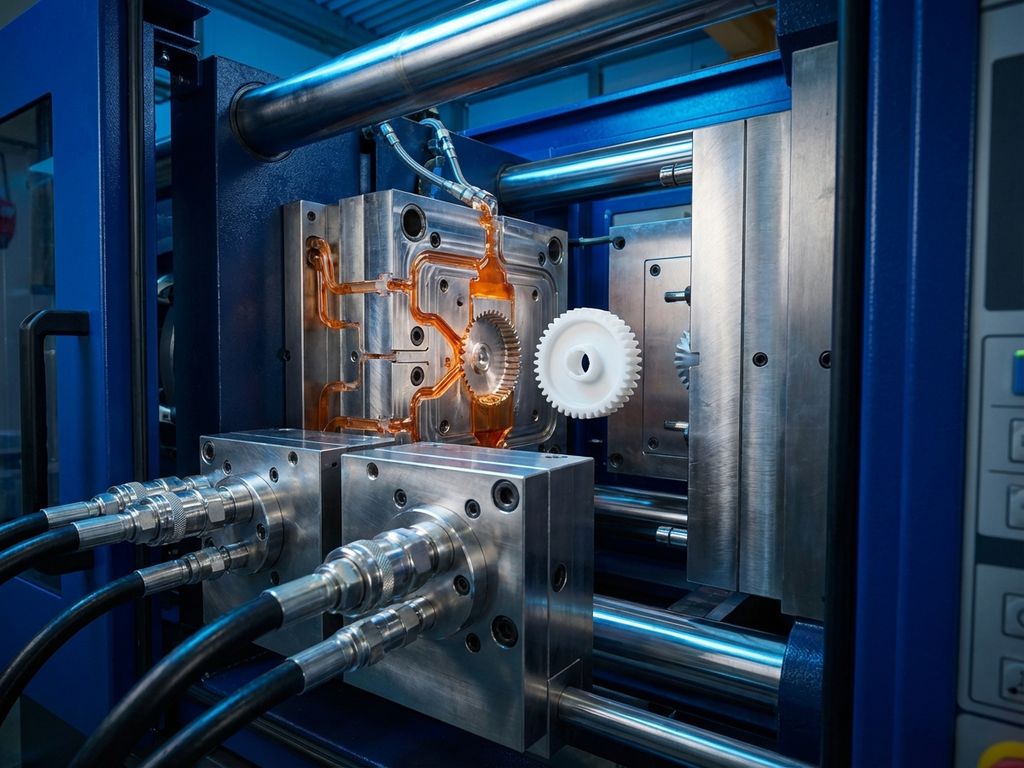
Flow marks in injection moulding appear as visible lines or streaks on plastic parts, typically occurring when molten material flows at different speeds or temperatures during injection. These surface defects compromise part aesthetics and can indicate process inconsistencies. Understanding their causes and implementing proper prevention strategies through injection moulding optimization ensures consistent, high-quality production outcomes.
What are flow marks in injection moulding and why do they occur?
Flow marks are visible surface defects that appear as wavy lines, streaks, or patterns on injection-moulded plastic parts. They form when molten plastic material flows through the mould cavity at varying speeds, temperatures, or pressures, creating distinct flow fronts that solidify at different rates and leave permanent marks on the finished surface.
These defects occur during the filling phase of injection moulding when the molten polymer encounters obstacles, changes in wall thickness, or temperature variations within the mould. As the material flows around corners, through gates, or past inserts, different flow rates create boundaries between faster- and slower-moving plastic streams. When these streams meet and solidify, they form visible lines that remain on the part surface.
Flow marks significantly impact both part aesthetics and functionality. They create an unprofessional appearance on visible surfaces, making products unsuitable for consumer applications. Beyond cosmetic concerns, flow marks can indicate underlying process problems that may affect part strength, dimensional accuracy, and overall quality consistency across production runs.
What causes flow marks to appear on injection-moulded parts?
Inconsistent melt temperatures represent the primary cause of flow mark formation, as temperature variations create different flow viscosities within the same injection cycle. When some material flows faster due to higher temperature whilst other areas remain cooler and more viscous, distinct flow boundaries develop that become permanently visible on the part surface.
Several process parameters contribute to flow mark development. Inadequate injection pressure fails to maintain consistent flow rates throughout cavity filling, allowing slower-moving material to create visible boundaries. Improper gate design, including poor placement or insufficient sizing, forces material through restrictive openings that disrupt smooth flow patterns. Insufficient venting prevents proper air evacuation, creating back pressure that interferes with uniform material distribution.
Mould temperature variations across different cavity sections cause localised flow rate differences. Cool spots in the mould create higher material viscosity, slowing flow in those areas whilst warmer sections allow faster material movement. These temperature inconsistencies directly translate into visible flow mark patterns on finished parts, making temperature control crucial for injection moulding optimization.
How can you prevent flow marks during the injection moulding process?
Process parameter optimization provides the most effective approach to flow mark prevention, focusing on maintaining consistent melt temperature, injection pressure, and flow rates throughout the moulding cycle. Proper temperature control ensures uniform material viscosity, whilst adequate pressure maintains steady flow without creating turbulence or flow front variations.
Key prevention strategies include adjusting injection speed profiles to match part geometry and wall thickness variations. Gradual speed changes prevent sudden flow disruptions that create visible boundaries. Implementing proper mould temperature control through balanced cooling channels ensures consistent heat removal across all cavity sections, eliminating temperature-related flow variations.
Material preparation techniques play a crucial role in flow mark prevention. Maintaining proper material drying eliminates moisture that can cause flow disruptions and surface defects. Consistent material temperature through proper barrel heating and residence time control ensures uniform melt viscosity. Enhanced venting systems allow complete air evacuation, preventing back pressure that interferes with smooth material flow and contributes to flow mark formation.
What mould design changes help eliminate flow marks?
Gate location optimization represents the most critical mould design factor for flow mark elimination, as proper gate placement ensures smooth, unobstructed material flow throughout the cavity. Strategic positioning minimises flow length differences and prevents material from converging at sharp angles that create visible flow boundaries on finished parts.
Runner system improvements significantly impact flow mark reduction. Balanced runner designs ensure equal flow rates to multiple cavities or different part sections. Proper runner sizing maintains adequate flow velocity without creating excessive pressure drops. Smooth transitions between runners and gates prevent flow disruptions that contribute to surface defects.
Cooling channel placement requires careful consideration to maintain uniform mould temperatures. Strategically positioned cooling lines prevent hot spots and temperature variations that cause flow rate differences. Surface finish considerations include proper cavity polishing to reduce flow resistance and eliminate surface irregularities that disrupt material flow. Enhanced venting systems with adequate vent placement and sizing ensure complete air evacuation without restricting material flow patterns.
How do material selection and preparation affect flow mark formation?
Plastic resin properties directly influence flow mark susceptibility, with material viscosity, flow characteristics, and temperature sensitivity determining how easily flow marks develop during processing. Materials with narrow processing windows or high viscosity variations require more precise control to prevent flow mark formation on finished parts.
Moisture content significantly affects material flow behaviour and surface quality. Hygroscopic materials absorb atmospheric moisture that creates steam during processing, disrupting flow patterns and creating surface defects. Proper material drying eliminates moisture-related flow problems and ensures consistent processing characteristics throughout production runs.
Material temperature control through proper barrel heating and residence time management maintains consistent melt viscosity. Temperature variations within the material itself create flow rate differences that appear as visible marks on part surfaces. Additive selection, including flow enhancers and processing aids, can improve material flow characteristics and reduce flow mark tendency. Proper material handling procedures prevent contamination and maintain consistent properties that support uniform flow during injection moulding operations.
How EAS change systems help with reducing flow marks in injection moulding
Quick mould change systems from EAS significantly reduce flow mark occurrence by maintaining consistent moulding conditions and eliminating setup variations that contribute to process inconsistencies. Our precision clamping technology ensures repeatable mould positioning and temperature stability across multiple production runs and mould changes.
EAS change systems contribute to flow mark reduction through:
- Consistent clamping force distribution that maintains uniform mould temperatures
- Rapid mould changeovers that preserve optimal processing conditions
- Precise mould positioning that ensures repeatable gate and runner performance
- Reduced setup time variations that maintain process parameter stability
- Enhanced temperature control through reliable mould connections
Our comprehensive quick-change solutions eliminate the temperature fluctuations and setup inconsistencies that commonly lead to flow mark formation. By maintaining stable processing conditions throughout production and changeover cycles, EAS systems support the consistent injection moulding optimization required for defect-free part production. These advanced systems find extensive use across various industrial applications where quality consistency is paramount. Contact us to learn how our quick mould change technology can improve your production quality and reduce flow mark defects.
