

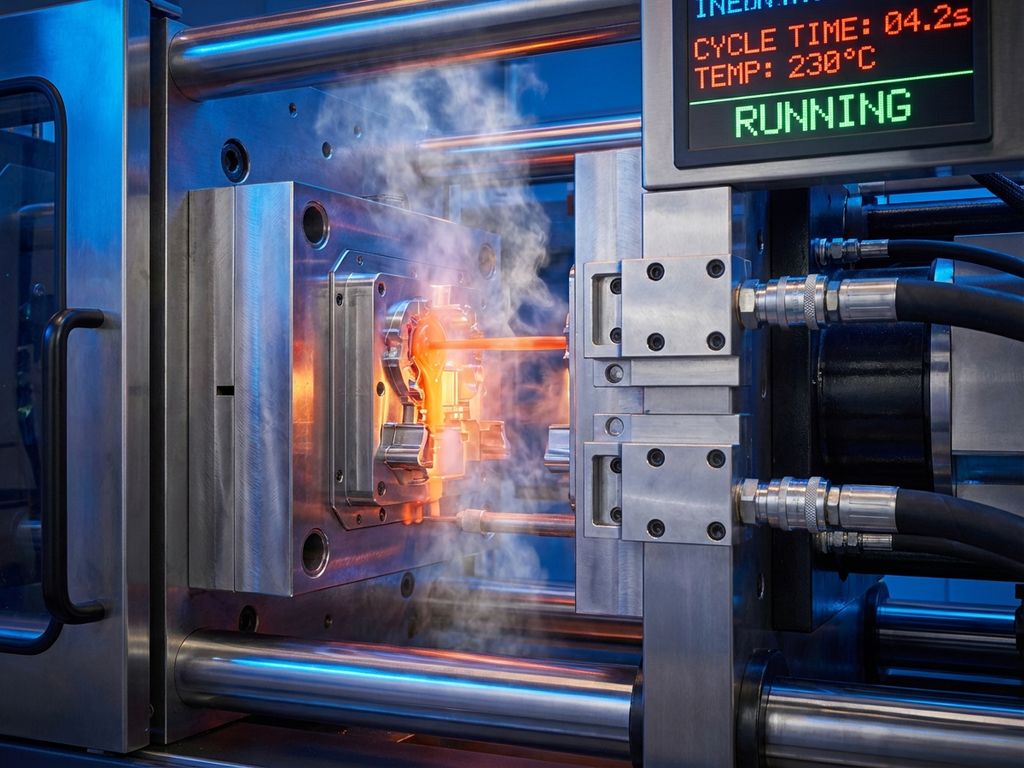
Reducing injection molding cycle time involves optimizing multiple interconnected factors that control how quickly parts are produced. The most impactful areas include cooling time optimization, parameter adjustments, mold design improvements, and implementing quick mold change systems. Effective injection molding optimization can significantly reduce cycle times while maintaining part quality and consistency.
What factors actually control injection molding cycle time?
Injection molding cycle time is determined by four primary phases: injection time, cooling time, mold open/close time, and part ejection. Cooling time typically accounts for 60–80% of the total cycle, making it the most significant factor in overall production efficiency.
The injection phase involves filling the mold cavity with molten plastic and applying holding pressure until the gate freezes. This phase usually takes 10–30 seconds, depending on part size and complexity. Mold open/close time includes the mechanical movement of platens and depends on machine specifications and safety requirements.
Part ejection time varies based on part geometry, ejection system design, and whether parts stick to the mold. Each phase presents optimization opportunities, but cooling time offers the greatest potential for cycle time reduction without compromising part quality. Understanding these phases helps manufacturers identify bottlenecks and prioritize improvement efforts for maximum impact on production efficiency.
How can you optimize cooling time without compromising part quality?
Cooling time optimization requires balancing faster heat removal with maintaining dimensional accuracy and surface finish quality. Proper cooling channel design and strategic coolant temperature control are the most effective approaches for reducing cooling time while preserving part integrity.
Cooling channel placement should follow the part geometry closely, maintaining uniform distances from the mold cavity. Conformal cooling channels, which follow complex part shapes, provide more efficient heat removal than traditional straight-line channels. The coolant temperature differential between inlet and outlet should remain within 2–5°C to ensure consistent cooling rates.
Material considerations play a crucial role in cooling optimization. Thermally conductive mold materials and proper thermal management help achieve faster, more uniform cooling. Additionally, optimizing wall thickness consistency reduces cooling time variations across the part. Monitoring mold temperature distribution through thermal imaging helps identify hot spots that may require additional cooling capacity or channel modifications.
What injection parameters should you adjust to reduce cycle time?
Critical injection molding parameters that directly affect cycle time include injection speed, pressure settings, hold time, and screw recovery time. Optimizing injection speed and reducing unnecessary hold time provides immediate cycle time improvements while maintaining consistent part quality.
Injection speed should be maximized within quality constraints, as faster filling reduces injection time and can improve part quality by reducing temperature loss during filling. However, excessive speed may cause flow marks, burning, or incomplete filling. Pressure settings must balance complete cavity filling with minimal flash formation.
Hold time optimization requires understanding the gate freeze time for specific materials and part geometries. Holding pressure longer than necessary after gate solidification wastes cycle time without improving part quality. Screw recovery time can be reduced through proper screw design, optimized back pressure, and appropriate barrel temperature profiles. These parameter adjustments require systematic testing to find the optimal balance between cycle time reduction and part quality maintenance.
Why does mold design play a crucial role in cycle time reduction?
Mold design elements directly impact cycle efficiency through gate design, runner systems, venting, and ejection mechanisms. Proper gate placement and runner system design enable faster filling and more efficient cooling, significantly reducing overall cycle time.
Gate design affects both filling time and cooling efficiency. Larger gates allow faster filling but require longer cooling time, while smaller gates may restrict flow but cool faster. Gate location influences flow patterns and cooling uniformity throughout the part. Runner systems should minimize pressure drop while ensuring balanced filling for multi-cavity molds.
Adequate venting prevents air traps that slow filling and cause defects, allowing higher injection speeds. Ejection system design impacts part removal time and the potential for part sticking. Well-designed ejection systems with proper pin placement and sufficient ejection force reduce cycle time and minimize part damage. Strategic mold design eliminates bottlenecks and creates streamlined molding processes that support consistent, fast production cycles.
How do quick mold change systems dramatically reduce overall production time?
Quick mold change technology transforms manufacturing efficiency by minimizing setup and changeover times from hours to minutes. Automated mold handling and standardized clamping systems enable rapid transitions between different products, maximizing overall equipment effectiveness and production flexibility.
Traditional mold changes require manual handling, extensive setup procedures, and lengthy trial runs that can consume 2–8 hours of production time. Quick mold change systems eliminate these inefficiencies through standardized connections, automated positioning, and preconfigured settings that reduce changeover time to 5–15 minutes.
The impact extends beyond individual changeover time reduction. Manufacturers can economically produce smaller batch sizes, respond faster to customer demands, and optimize production scheduling. Quick mold change systems enable just-in-time manufacturing approaches and reduce inventory requirements. For manufacturers running multiple products, the cumulative time savings from faster changeovers often exceeds the benefits from individual cycle time optimization, making it a critical component of injection molding optimization strategies.
How EAS change systems help with injection molding cycle time reduction
We provide comprehensive solutions for injection molding optimization through advanced quick mold change systems, adaptive clamping technology, and automated mold handling equipment. Our solutions address both individual cycle time optimization and overall production efficiency improvements.
Our injection molding cycle time reduction applications include:
- Quick mold change systems that reduce changeover times from hours to minutes
- Adaptive clamping technology for consistent, rapid mold securing and release
- Automated mold transportation systems for safe, efficient mold handling
- Standardized coupling systems for utilities and ejector connections
- Mold tilting and inspection units for faster setup and quality verification
Our implementation approach includes comprehensive ROI calculations, application engineering support, and complete project management from design through installation. We work with manufacturers to identify optimization opportunities and deliver measurable improvements in production efficiency. Contact us today to discover how our quick mold change solutions can transform your injection molding operations and dramatically reduce your overall production time.
