

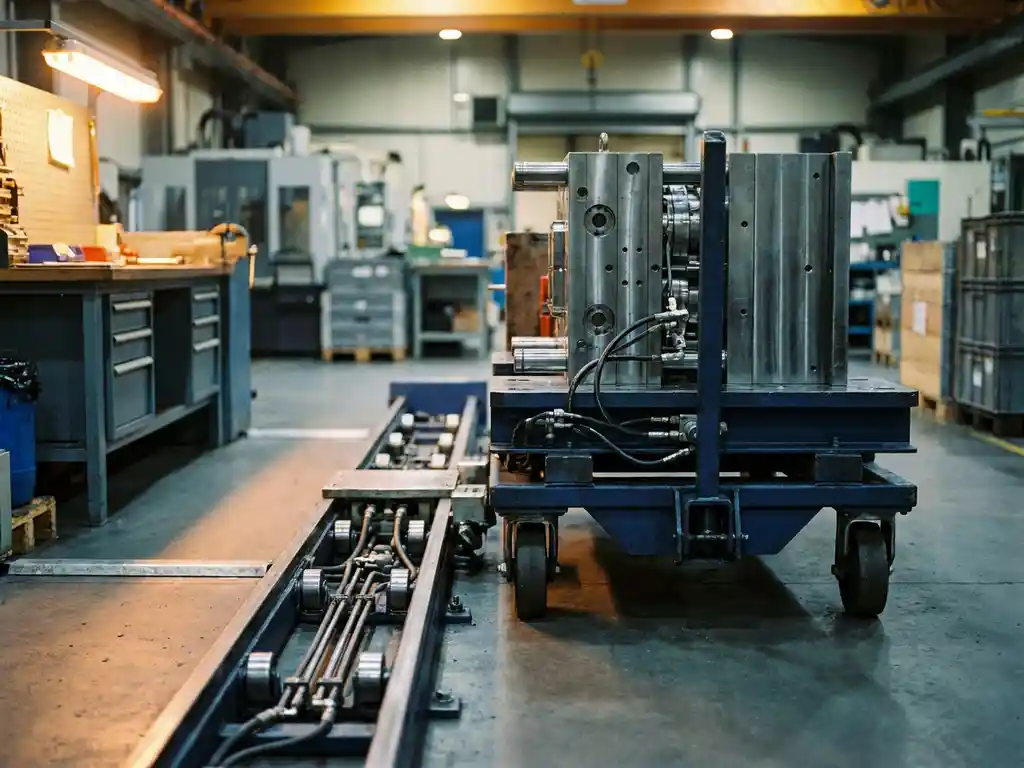
A mold cart is a wheeled transport device used to move heavy molds safely around the shop floor, while a mold transfer system is a more complete, often mechanized setup that moves the mold directly into and out of the injection molding machine as part of a structured changeover process. The distinction matters because one handles logistics between machines, while the other is designed to reduce changeover time at the press. The sections below break down each tool, their differences, and how to choose the right approach for your operation.
What does a mold cart actually do on the shop floor?
A mold cart is a wheeled platform designed to transport heavy molds safely between storage areas, maintenance stations, and injection molding machines. It supports the mold during transit, protects it from damage, and reduces the physical risk to operators who would otherwise need cranes or forklifts for every move. Mold carts are a foundational piece of any organized mold handling workflow.
On a busy shop floor, molds are among the most valuable and delicate assets in the facility. A dropped or mishandled mold can mean costly repairs, scrapped production runs, and unplanned downtime. Mold carts solve this by providing a stable, height-adjustable surface that can be rolled directly to the machine, keeping the mold at the right working height and reducing handling steps.
Most mold carts are built to handle specific weight ranges and can be configured with rollers, guide rails, or locking mechanisms to suit different machine setups. Some are manual, while others are hydraulically assisted for height adjustment. In either case, their primary job is safe, efficient transport rather than automated changeover.
What is a mold transfer system and how does it work?
A mold transfer system is a coordinated set of components, including roller tracks, die lifters, guide rails, and sometimes automated clamping mechanisms, that moves a mold from a staging position directly into the machine platens and secures it for production. Unlike a mold cart, which stops at the machine, a transfer system completes the last critical meters of the changeover process.
The system typically works in a sequence. The new mold is pre-staged on a transfer table or cart aligned with the machine opening. Once the old mold is released and moved out along one set of roller tracks, the new mold slides in along the same or parallel tracks, guided precisely into position. Clamping then secures the mold, and the machine is ready to run.
This approach eliminates the need for a crane or forklift to lift the mold into the machine, which is often the slowest and most hazardous part of a traditional changeover. By keeping the mold at the correct height and guiding it horizontally into position, a transfer system dramatically reduces both changeover time and operator risk. The result is a process that can often be completed by a single operator rather than a full crew.
What are the key differences between a mold cart and a mold transfer system?
The key difference is scope. A mold cart handles transportation across the facility, while a mold transfer system handles the precise, controlled movement of the mold into and out of the machine itself. A cart gets the mold to the machine; a transfer system completes the changeover. They serve different stages of the same workflow and are not direct substitutes for each other.
Here is a side-by-side comparison of the two:
- Function: Mold carts transport molds between locations; transfer systems load and unload molds from machines.
- Automation level: Carts are typically manual or semi-hydraulic; transfer systems can be fully mechanized or automated.
- Changeover impact: Carts reduce handling risk; transfer systems directly reduce changeover time at the press.
- Integration: Transfer systems are built into or aligned with the machine; carts are standalone and mobile.
- Complexity: Carts are simpler and more flexible; transfer systems require alignment, engineering, and sometimes machine modification.
In many production environments, both are used together. The mold cart brings the mold from storage to the machine, and the transfer system takes it from there into the press. Understanding this division of roles helps manufacturers invest in the right equipment at the right stage. You can explore the full range of mold handling products available to support every step of this process.
When should a manufacturer choose a mold cart over a full transfer system?
A mold cart is the right choice when the primary need is safe, flexible transport across the facility rather than a faster changeover at the machine. If changeover frequency is low, if the operation involves many different machine types, or if budget constraints require a phased investment, starting with quality mold carts is a practical and sensible approach.
Mold carts also make more sense in facilities where molds vary significantly in size and weight, making it harder to standardize a transfer system across all machines. They offer flexibility that fixed transfer systems cannot always match.
A full transfer system becomes the stronger investment when changeover time is a measurable bottleneck, when the same molds are swapped on the same machines repeatedly, or when operators are spending significant time and effort on each changeover. The more frequent and repetitive the changeover, the faster a transfer system pays for itself.
How much faster are mold changes with a transfer system versus a cart?
A well-designed mold transfer system can reduce changeover time from several hours to under 30 minutes, and in optimized setups, to under 10 minutes. A mold cart alone does not reduce changeover time at the machine; it only reduces transit time and handling effort. The time savings from a transfer system come from eliminating crane lifts, reducing alignment steps, and enabling a single operator to complete what previously required a team.
The actual time difference depends on several factors: the weight and size of the mold, the current changeover process, the machine type, and whether other quick mold change components such as adaptive clamping systems and coupler systems are also in place. A transfer system works best as part of a broader quick mold change setup where each step in the changeover has been engineered for speed and repeatability. Reviewing real-world mold change applications can help illustrate how these systems perform across different production environments.
For manufacturers running multiple changeovers per shift or per day, even a 60-minute reduction per change can translate into significant additional production capacity across a year.
Can a mold cart be integrated into a larger quick mold change system?
Yes, mold carts can and often are integrated into a larger quick mold change system. In a fully designed QMC setup, the mold cart serves as the mobile staging element that connects storage or maintenance areas to the transfer system at the machine. When the cart is designed with compatible roller surfaces, height alignment, and guide rail interfaces, it becomes a seamless link in a continuous, efficient changeover chain.
Integration requires that the cart’s working height matches the machine’s transfer rails and that the roller or guide system is compatible with the transfer table or die lifter. When these elements are engineered together from the start, the mold moves from storage to production-ready without any lifting, repositioning, or manual adjustment.
This kind of integrated thinking also extends to mold maintenance. Mold carts that connect to inspection tables or mold tilting units allow teams to bring molds through a complete care cycle before they re-enter production, supporting both uptime and mold longevity.
How EAS Change Systems helps with mold handling and changeover efficiency
We design and supply complete solutions that cover every stage of the mold handling and changeover process, from the first move out of storage to the moment the machine is running again. Whether your operation needs mold carts, a full transfer system, or an integrated quick mold change setup, we engineer the right solution for your machines, your molds, and your production targets.
Our offering includes:
- Mold change tables and transportation vehicles that safely move molds across the facility and stage them for changeover
- Die lifters and pre-rollers that enable smooth horizontal transfer into and out of the press
- Adaptive clamping systems and coupler systems that reduce the time spent securing and connecting molds at the machine
- Mold maintenance solutions including inspection units, mold rotators, and inspection tables, supported by our Tool Care program to keep molds in optimal condition before they enter production
- Project management, application engineering, and ROI calculations to help you make the right investment decision with full visibility on the return
We have been helping manufacturers reduce changeover times and improve factory efficiency since 1985, with engineering and production facilities across three continents and a global installation network. If you want to understand which combination of mold carts, transfer systems, and quick mold change components is right for your facility, contact EAS Change Systems today to speak with one of our application engineers.