

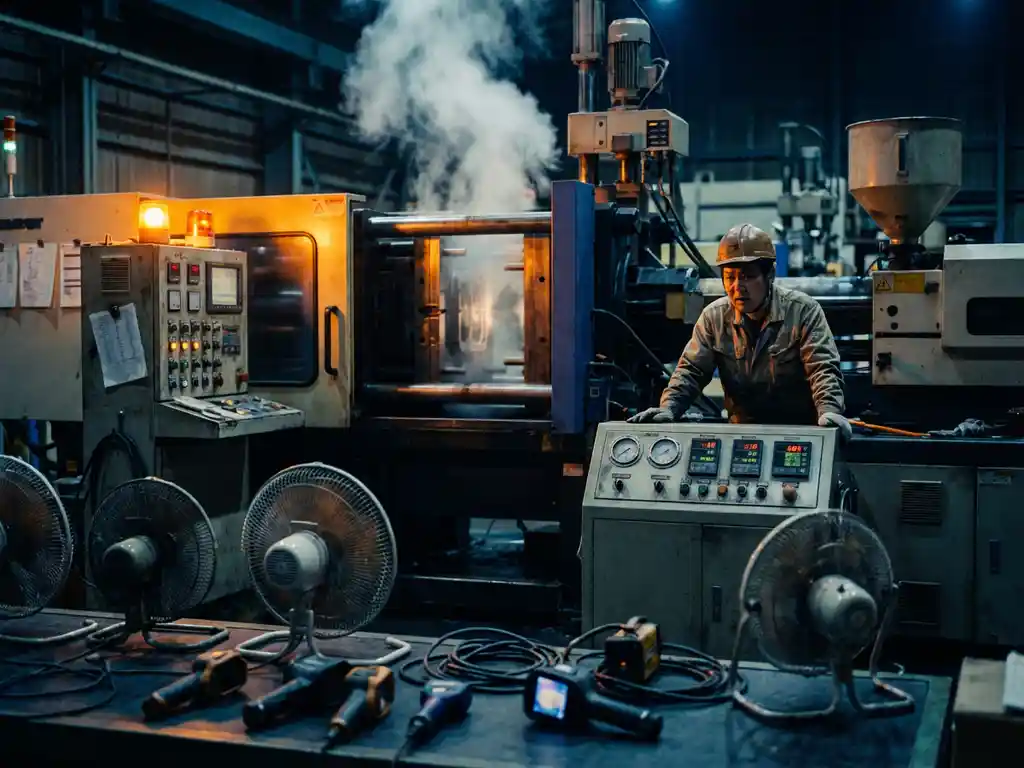
Production downtime in injection molding operations can cost manufacturers thousands of dollars per hour, making temperature control a critical factor in maintaining efficient operations. Mold temperature directly affects cycle times, part quality, and the frequency of production interruptions, creating a cascade effect that can significantly extend downtime periods.
Understanding the relationship between mold temperature and reduced production downtime helps manufacturers implement effective injection molding troubleshooting strategies. By addressing temperature-related issues proactively, companies can minimize costly interruptions and maintain a consistent production flow.
What is mold temperature, and why does it affect production?
Mold temperature refers to the controlled heating or cooling of injection mold surfaces to optimize the molding process and part quality. Proper mold temperature control affects material flow, cooling rates, part dimensional accuracy, and surface finish, directly impacting production efficiency and downtime frequency.
Temperature control systems maintain consistent mold temperatures through heated oil, water circulation, or electric heating elements. The optimal temperature range varies depending on the plastic material being processed, part geometry, and quality requirements. For example, crystalline materials like polyethylene typically require higher mold temperatures than amorphous materials like polystyrene.
When mold temperatures operate outside optimal ranges, several production issues emerge. Low temperatures can cause incomplete filling, poor surface finish, and increased injection pressures, while excessive temperatures lead to longer cooling times, part warpage, and dimensional instability. These temperature-related defects force operators to stop production for adjustments, cleaning, or part inspection, directly increasing downtime.
How does improper mold temperature increase downtime?
Improper mold temperature increases downtime by causing part defects, equipment malfunctions, and process instabilities that require immediate production stops for correction. Temperature deviations can lead to rejected parts, mold damage, and extended troubleshooting periods that significantly impact overall equipment effectiveness.
Part quality issues represent the most common downtime trigger related to temperature problems. When mold temperatures run too low, materials may not flow properly into thin sections or complex geometries, creating short shots or incomplete parts. These defects require production stops to adjust process parameters, inspect tooling, and potentially clean mold cavities of partially cured material.
Excessive mold temperatures create different but equally disruptive problems. High temperatures extend cooling times, forcing longer cycle times that reduce hourly production rates. Additionally, overheated molds can cause material degradation, leading to contamination issues that require thorough cleaning and purging procedures. In severe cases, thermal expansion can cause mold components to bind or jam, necessitating emergency maintenance and extended downtime periods.
What causes mold temperature fluctuations during production?
Mold temperature fluctuations during production result from cooling system malfunctions, ambient temperature changes, inconsistent cycle times, and heat transfer variations within the mold structure. These fluctuations disrupt process stability and create conditions that lead to quality issues and production interruptions.
Cooling system problems represent the primary cause of temperature instability. Blocked cooling channels, pump failures, or inadequate flow rates prevent consistent heat removal from the mold. Sediment buildup in cooling lines restricts water flow, while air pockets create hot spots that cause uneven temperature distribution across the mold surface.
External factors also contribute to temperature variations. Seasonal changes in ambient temperature affect cooling system performance, while variations in production schedules create thermal cycling that impacts mold stability. Additionally, different part geometries and material types require temperature adjustments between production runs, and inadequate transition procedures can create extended periods of temperature instability.
How can quick mold change systems reduce temperature-related downtime?
Quick mold change systems reduce temperature-related downtime by maintaining consistent thermal conditions during mold changeovers and enabling rapid temperature stabilization when switching between different production requirements. These systems preserve cooling connections and temperature settings, eliminating the thermal cycling that typically occurs during manual mold changes.
Automated mold change systems maintain cooling line connections throughout the changeover process, preventing temperature loss that would otherwise require extended warm-up periods. Traditional manual changeovers often involve disconnecting cooling lines, allowing molds to reach ambient temperature and requiring significant time to re-stabilize thermal conditions. Quick-change systems preserve these connections, maintaining temperature continuity.
Advanced quick-change systems also incorporate temperature monitoring and control features that automatically adjust heating and cooling parameters based on the incoming mold requirements. This automation reduces the manual setup time typically required for temperature optimization and minimizes the trial-and-error period that often extends changeover downtime. The result is a faster return to stable production conditions and reduced overall downtime.
What temperature control strategies minimize production interruptions?
Effective temperature control strategies that minimize production interruptions include predictive monitoring systems, preventive cooling system maintenance, standardized temperature procedures, and rapid response protocols for temperature deviations. These strategies focus on preventing temperature-related issues before they cause production stops.
Implementing continuous temperature monitoring with alarm systems provides early warning of developing problems. Modern temperature controllers can detect gradual temperature drift, cooling system flow reductions, or heating element degradation before they cause part quality issues. This predictive approach allows maintenance teams to address problems during planned downtime rather than during emergency stops.
Preventive maintenance programs specifically targeting cooling systems prevent many temperature-related interruptions. Regular cleaning of cooling channels, pump inspections, and flow-rate verification maintain system performance and prevent sudden failures. Additionally, keeping spare heating elements and temperature sensors on hand enables rapid repairs when components fail unexpectedly.
How EAS Change Systems Helps Reduce Temperature-Related Downtime
We provide comprehensive quick mold change solutions that significantly reduce temperature-related production downtime through advanced clamping systems and automated changeover processes. Our QMC systems maintain cooling line connections during mold changes, preserving thermal stability and eliminating extended warm-up periods that traditionally add hours to changeover times.
Our solutions address temperature-related downtime through several key features:
- Adaptive clamping systems that maintain consistent cooling connections throughout changeover processes
- Multi-coupler systems that automatically connect cooling, heating, and monitoring lines simultaneously
- Mold change tables with integrated temperature control capabilities
- Project management services that optimize temperature control strategies for specific applications
- ROI calculations that demonstrate the financial impact of reduced temperature-related downtime
Contact our application engineering team today to learn how our quick mold change systems can reduce temperature-related downtime and improve overall production efficiency. We provide comprehensive assessments and customized solutions designed to optimize your specific molding operations.