

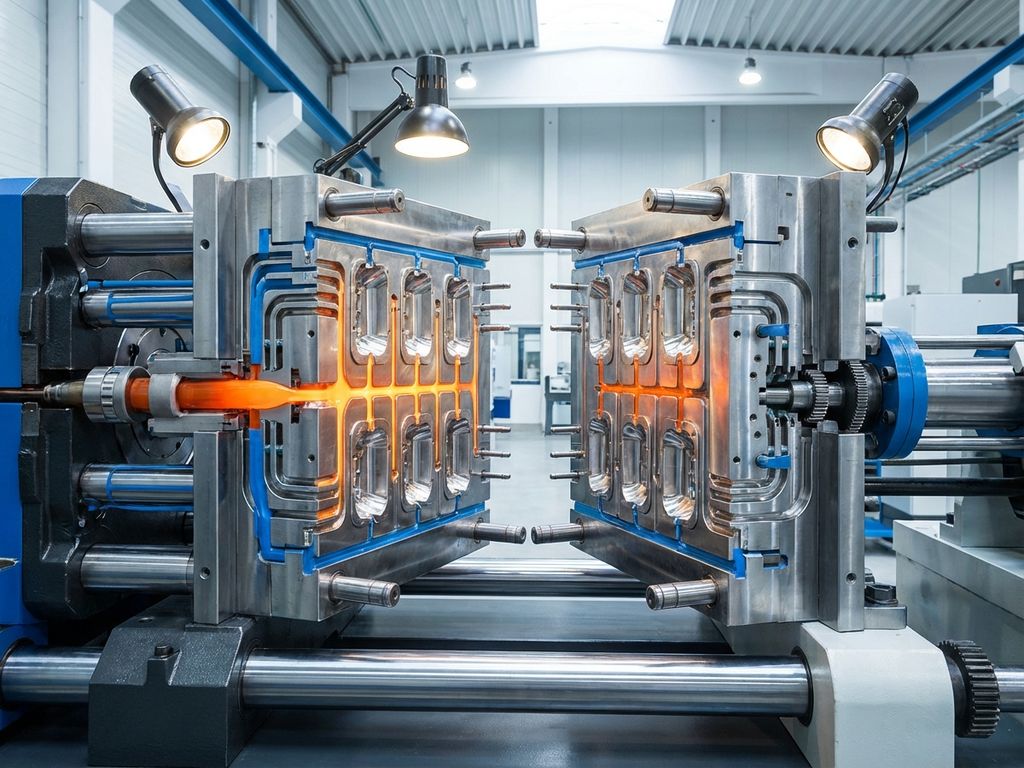
Multi-cavity injection molding optimization involves developing tooling with multiple sub-cavities to maximize production efficiency while maintaining consistent quality across all parts. Success requires proper cavity balancing, strategic runner system design, precise temperature control, and coordinated process parameters. This approach can dramatically increase production output while reducing per-part costs in high-volume manufacturing.
What is Multi-Cavity Injection Molding and Why is it Important?
Multi-cavity injection molding uses a single mold with multiple identical cavities to produce several parts in one injection cycle. Instead of producing one part per cycle, manufacturers can create 2, 4, 8, 16, or even more parts simultaneously, depending on part size and mold design constraints.
The system works by distributing molten plastic through a runner system that feeds each cavity simultaneously. During injection, plastic flows from the machine nozzle through the main runner, into primary runners, then through secondary runners and gates into each individual cavity. All cavities fill and cool together, producing multiple identical parts in the same cycle time as a single part.
Manufacturers choose multi-cavity systems because they dramatically improve production efficiency. Instead of running 1,000 cycles to produce 1,000 parts, an 8-cavity mold generates the same quantity in just 125 cycles. This reduces machine time, energy consumption, and labor costs per part. The approach proves particularly valuable for high-volume production applications where setup costs can be amortized across thousands or millions of parts.
Beyond efficiency gains, multi-cavity injection molding provides better material utilization and consistent processing conditions. All parts experience identical temperature, pressure, and cooling profiles, resulting in more uniform quality compared to separate molding cycles.
How to Achieve Proper Cavity Balancing in Multi-Cavity Molds?
Cavity balancing ensures all cavities fill simultaneously with equal pressure and flow rates. This requires designing runner systems where plastic travels the same distance and encounters identical resistance to reach each cavity. Without proper balancing, some cavities fill before others, leading to quality variations and potential defects.
The key principle involves maintaining equal flow lengths from the main runner to each cavity gate. This means designing runner layouts where the total path length – including primary runners, secondary runners, and gates – remains constant for every cavity. Even small differences in flow path can create filling imbalances that compromise part quality.
Runner cross-sectional areas must also remain consistent throughout the system. Runners that narrow or varying diameters can create pressure drops that favor certain cavities over others. Gates should be identical in size, shape, and relative position to each cavity to ensure uniform filling patterns.
Temperature control plays a crucial role in balancing. Hot runner systems often provide superior balancing compared to cold runners because they maintain consistent melt temperature throughout the distribution system. Cold runner designs require careful attention to runner sizing and cooling to prevent temperature variations that affect flow characteristics.
Testing and validation involve monitoring fill patterns, measuring part weights, and checking dimensional consistency across all cavity positions. Adjustments to gate sizes, runner diameters, or processing conditions help fine-tune balancing for optimal results.
What are the Key Design Considerations for Optimizing Multi-Cavity Molds?
Successful multi-cavity mold design requires careful attention to runner system layout, cooling systems, structural integrity, and venting. Each element must work together to ensure consistent filling, uniform cooling, and reliable part ejection across all cavities while maintaining mold durability under high-volume production conditions.
Runner system layout forms the foundation of multi-cavity design. Balanced runner configurations like H-pattern, star, or tree patterns distribute material evenly while minimizing pressure losses. Runner diameters should be large enough to maintain flow but small enough to minimize material waste and cooling time.
Gate design and positioning significantly influences part quality and cycle time. Gates must be sized to completely fill cavities without creating excessive shear or pressure drops. Position affects weld line formation, surface finish, and dimensional accuracy. Common approaches include edge gates, tunnel gates, or hot tip gates, depending on part geometry and quality requirements.
Cooling channel configuration becomes more complex with multiple cavities. Each cavity needs adequate cooling while maintaining temperature uniformity across the mold. This often involves multiple cooling circuits, conformal cooling channels, or strategic positioning of cooling lines to prevent hot spots that could cause warpage or dimensional variations.
Venting requirements multiply with additional cavities. Each cavity needs proper air evacuation to prevent trapped air, burns, or incomplete filling. Vent positioning, depth, and width must be optimized for each cavity position, considering parting line design and accessibility for maintenance.
Structural considerations include adequate steel thickness between cavities, proper support for thin sections, and robust ejector systems. The mold must withstand repeated high-pressure cycles without deflection that could affect part quality or mold longevity.
How to Troubleshoot Common Multi-Cavity Injection Molding Issues?
Multi-cavity injection molding problems typically manifest as inconsistencies between cavity positions, including irregular filling, dimensional variations, or quality differences. Systematic troubleshooting involves identifying whether issues stem from mold design, processing conditions, or material factors, then implementing targeted solutions.
Irregular fill patterns usually indicate runner imbalances or gate sizing issues. When certain cavities consistently fill slower or faster than others, examine runner lengths, gate sizes, and flow restrictions. Solutions include adjusting gate sizes, modifying runner diameters, or redesigning the distribution system for better balance.
Short shots in specific cavities often result from insufficient injection pressure, blocked venting, or inadequate gate sizing. Gradually increase injection pressure while monitoring other cavities for overpacking. Clear blocked vents and consider enlarging gates for affected cavities. Temperature adjustments can also improve flow in difficult-to-fill areas.
Dimensional variations between parts indicate irregular cooling, pressure differences, or material degradation. Check cooling water flow rates and temperatures in all zones. Ensure injection and hold pressures reach all cavities equally. Monitor material residence time and processing temperatures to prevent degradation that affects shrinkage rates.
Flash typically occurs when clamp force is insufficient or mold surfaces are damaged. Increase clamp force if possible, but ensure this doesn’t create other issues. Inspect parting lines and cavity surfaces for wear or damage that allows material leakage.
Quality inconsistencies across cavity positions often trace back to processing parameter variations. Use cavity pressure sensors when available to monitor actual conditions at each position. Adjust injection velocity profiles, hold pressures, or cooling times to compensate for natural variations in the mold system.
What Setup and Process Parameters Optimize Multi-Cavity Production?
Optimizing multi-cavity production requires coordinated machine setup, precise injection molding parameters, and systematic monitoring to ensure consistent results across all cavities. Success depends on balancing fill rates, pressures, temperatures, and timing to account for the increased complexity of multiple simultaneous parts.
Machine setup begins with proper clamp force calculation based on the total projected area of all cavities plus runners. Insufficient clamping can cause flash or dimensional issues, while excessive force wastes energy and unnecessarily stresses the mold. Calculate total projected area and apply appropriate safety factors for your specific application.
Injection pressure and velocity optimization becomes more critical with multiple cavities. Higher pressures may be necessary to completely fill all cavities, but excessive pressure can cause overpacking in easy-to-fill positions. Use multi-stage injection profiles that provide sufficient pressure for filling while preventing overpacking during the hold phase.
Temperature control strategies must account for increased heat generation from larger shot sizes and longer flow paths. Barrel temperatures may need adjustment to maintain proper melt viscosity through the extended flow network. Mold temperatures require careful balancing to ensure uniform cooling across all cavity positions.
Cycle time optimization involves balancing cooling time requirements with production efficiency goals. While multi-cavity molds increase parts per cycle, they often require slightly longer cooling times due to the larger thermal mass. Monitor part quality and dimensional stability to determine minimum acceptable cooling times.
Process monitoring methods should track key parameters for each cavity position when possible. Cavity pressure sensors, temperature monitoring, and systematic quality checks help identify developing issues before they affect production. Establish control limits based on acceptable variation ranges and implement corrective actions when parameters drift from these limits.
How Do EAS Change Systems Help Optimize Multi-Cavity Injection Molding?
EAS Change Systems provides comprehensive solutions that address the unique challenges of multi-cavity injection molding through advanced quick-change mold technology and precision tooling systems. Our solutions reduce setup times, improve mold alignment accuracy, and ensure consistent production across all cavity positions for optimal injection molding results.
Our multi-cavity optimization solutions include:
- Quick-change mold systems that enable rapid transitions between different multi-cavity configurations, reducing changeover time from hours to minutes
- Adaptive clamping systems that provide precise and repeatable mold positioning, essential for maintaining cavity balance and part quality consistency
- Ejector couplings that ensure uniform part removal across all cavities, preventing damage and maintaining cycle time efficiency
- Complete turnkey solutions including mold transport, positioning, and connection systems designed specifically for multi-cavity production requirements
Ready to optimize your multi-cavity injection molding operations? Contact our applications engineering team to discuss how our quick-change mold systems can reduce your setup times, improve production consistency, and maximize the efficiency benefits of your multi-cavity tooling investments.
