

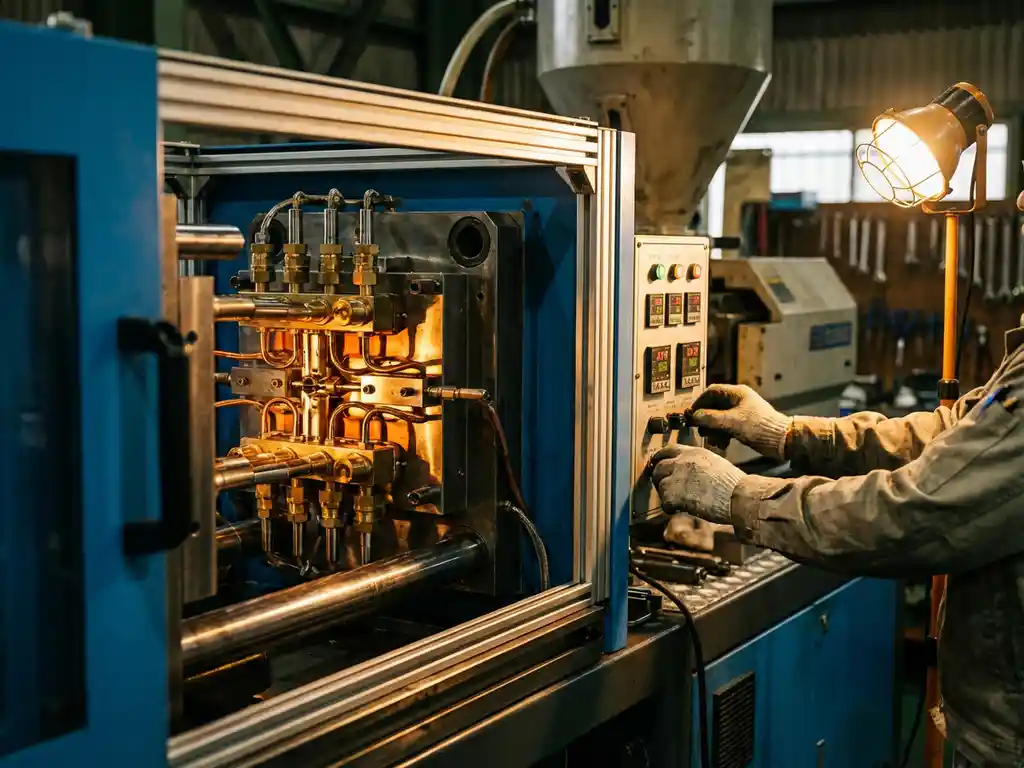
Manufacturing downtime can cost companies thousands of dollars per hour, making production downtime reduction a critical priority for manufacturers worldwide. Hot runner systems have emerged as a potential solution for injection molding operations seeking to minimize interruptions and maximize efficiency.
While these systems require a significant upfront investment, they promise substantial benefits in terms of reduced cycle times, eliminated material waste, and fewer production stoppages. Determining whether hot runner technology aligns with your manufacturing goals requires a careful evaluation of costs, benefits, and operational requirements.
What Are Hot Runner Systems and How Do They Work?
Hot runner systems are heated manifold networks that keep plastic material in a molten state throughout the injection molding process, delivering material directly to mold cavities without creating waste runners. The system consists of a heated manifold, temperature controllers, and hot runner nozzles that keep plastic at an optimal processing temperature from the injection unit to the part cavities.
The core components work together seamlessly to ensure consistent material flow. The heated manifold distributes molten plastic through precisely controlled channels, while temperature controllers maintain uniform heat distribution across the entire system. Hot runner nozzles, positioned at each cavity location, deliver material with precise timing and pressure control.
This technology eliminates the traditional runner system that connects the sprue to individual cavities, reducing material waste and cycle times. The heated pathways prevent material from solidifying between cycles, enabling continuous production without the need to remove and regrind runner waste.
What’s the Difference Between Hot Runner and Cold Runner Systems?
Hot runner systems keep plastic in a molten state throughout the injection process, while cold runner systems allow material to solidify in channels between the sprue and cavities, creating waste that must be removed after each cycle. This fundamental difference affects material usage, cycle times, and overall production efficiency.
Cold runner systems are simpler and less expensive initially, requiring basic mold designs with channels that guide material from the injection point to the part cavities. However, they generate significant waste material that must be separated, reground, and often blended back into virgin material for reuse.
Hot runner technology eliminates this waste stream entirely, delivering material directly to cavities without creating excess plastic. The heated manifold system requires sophisticated temperature control and a higher initial investment but provides superior material utilization and faster production cycles.
Maintenance requirements also differ significantly between the two approaches. Cold runner systems need regular cleaning of solidified material from channels, while hot runner systems require ongoing temperature monitoring and occasional nozzle maintenance to prevent material degradation or blockages.
How Do Hot Runner Systems Reduce Manufacturing Downtime?
Hot runner systems reduce manufacturing downtime by eliminating runner removal steps, minimizing material flow issues, and reducing the frequency of mold changes and maintenance interventions. Keeping material continuously molten helps prevent blockages and ensures consistent flow rates throughout production runs.
Traditional cold runner systems require operators to separate parts from runner waste after each cycle, adding handling time and increasing the potential for errors. Hot runner technology eliminates this step entirely, allowing parts to be ejected directly from the mold without additional processing.
Consistent temperature control in hot runner systems also helps prevent common injection molding issues such as short shots, flow marks, and pressure variations that can halt production. Material remains at an optimal processing temperature, reducing the likelihood of quality problems that require production stops.
Additionally, eliminating regrind processing reduces equipment requirements and potential bottlenecks in material preparation. Manufacturers no longer need to coordinate runner collection, grinding, and material blending operations that can create delays in production schedules.
What Are the Real Costs of Installing Hot Runner Systems?
Hot runner system installation costs typically range from $15,000 to $100,000 or more, depending on system complexity, the number of cavities, and specific application requirements. The investment includes the hot runner manifold, temperature controllers, specialized nozzles, and integration labor costs.
Beyond initial hardware costs, manufacturers must consider ongoing operational expenses, including increased energy consumption for heating elements, specialized maintenance requirements, and potential replacement-parts inventory. Temperature controllers and heating elements require regular calibration and eventual replacement.
However, these costs must be weighed against significant savings from eliminating material waste, reducing cycle times, and decreasing labor requirements. Many operations see material savings of 20–30% immediately upon installation, with cycle time reductions of 10–25% depending on part geometry and production parameters.
The complexity of installation also affects total project costs. Retrofitting existing molds requires careful engineering analysis and may necessitate mold modifications, while new mold designs can integrate hot runner systems more cost-effectively from the outset.
When Should Manufacturers Choose Hot Runner Over Cold Runner?
Manufacturers should choose hot runner systems when producing high-volume parts, using expensive materials, or molding complex geometries where reduced material waste and shorter cycle times provide substantial cost benefits. Operations running continuous production schedules with minimal changeovers see the greatest advantages from hot runner technology.
High-volume production scenarios justify the initial investment through accumulated savings over millions of cycles. Eliminating runner waste becomes increasingly valuable as production quantities increase, particularly with expensive engineering plastics or specialized materials.
Complex part geometries with long flow paths benefit significantly from hot runner systems, as maintaining consistent material temperature helps prevent flow-related defects that are common with cold runner approaches. Multi-cavity molds also see improved part-to-part consistency with hot runner technology.
Conversely, low-volume production, frequent mold changes, or prototype development may favor cold runner systems due to lower initial costs and greater flexibility. Short production runs may not generate sufficient savings to offset hot runner investment costs.
How Do You Calculate ROI for Hot Runner System Investments?
Calculating ROI for hot runner systems involves comparing total implementation costs against annual savings from eliminating material waste, reducing cycle times, and decreasing labor requirements. Most manufacturers achieve payback periods of 12–36 months, depending on production volume and material costs.
Material savings calculations should include the cost of eliminated runner waste, reduced regrind processing, and improved material utilization rates. For expensive materials, these savings can reach thousands of dollars per month even in moderate-volume operations.
Cycle time improvements translate directly into increased production capacity without additional equipment investment. A 15% cycle time reduction effectively increases hourly output, allowing manufacturers to meet demand with existing resources or reduce overtime requirements.
Additional factors in ROI calculations include fewer quality issues, reduced maintenance requirements for material handling equipment, and improved operator productivity. These indirect benefits often contribute significantly to overall system value but require careful measurement to quantify accurately.
How EAS Change Systems Helps with Production Efficiency
We specialize in quick mold change solutions that complement hot runner investments by minimizing changeover times and maximizing production uptime. Our comprehensive approach to production downtime reduction includes:
- Quick mold change systems that reduce setup times from hours to minutes
- Adaptive clamping systems designed for hot runner mold compatibility
- Comprehensive ROI calculations that factor in both hot runner and quick-change benefits
- Integration support for combining hot runner technology with rapid changeover systems
- Ongoing service and maintenance programs to ensure optimal system performance
Our engineering team works closely with manufacturers to optimize both hot runner implementation and mold change efficiency, creating comprehensive solutions for production downtime reduction across various manufacturing applications. Contact us today to discuss how our quick-change systems can maximize your hot runner investment and transform your injection molding operations.